Tampilkan postingan dengan label Ecology. Tampilkan semua postingan

On the Ecology of the Zorbo

"They don't like us, but they like us to eat. " - Ralfish Dortkud, Nezumi Spy

Nomenclature: Zorba, Zorbo, Sorbers, Dirt bear,

Description: Small bear like creatures with fangs and claws and black beady eyes.

Things that are known:
  • It hungers for the flesh of humans and humanoids
  • It has the ability to absorb the traits of objects and items around it, as well as draining magic items of their energy
  • It looks very much like a koala bear.


Rumors and other whispers in the dark:
  • Its dying curse is to leave adventurers with the shameful Mark of Zorbo, a Z on their forehead, which to those in the know is occasion for ridicule and mirth.
  • They are said to give birth to 1 to 2 live young every 3 years. 
  • Zorbo are created by pickling koalas in mysterious alchemical concoctions for seven days while performing a ritual known as "chanting the seven mately groans'.
  • Killing a Zorbo with a melee weapon traps your weapon in the corpse 4 out of 6 times.
  • Zorbo were originally designed to go in steel cages, fired from siege engines. They would take on the aspect of steel, and when the cage burst on impact, they rampaged. They were the winners of a contest, where a wizard submitted his life form. Unlike golems, they were cheap to breed. Because they had a meat form, they were relatively easy to feed and house. And when they became burrs digging through infantry ranks, that put a smile on the commander's face.
  • Zorbo are children of the Gum-Tree God, tending the gardens of creamtime.
  • Some Zorbos absorb brains, and they are called Zorbies.
  • Zorbos are universally double jointed. 
  • Zorbo claws make excellent mace heads, maintaining their absorbing power even after death. 
  • Zorbo were created by religious xorn. They prayed for something they could hunt through the earth, after seeing what joy their underdark neighbors took in the practice. The original zorbo were holy creatures, reserved for hunting through the earth on xorn holy days. The trick was to catch and kill the zorbo when it was formed of the most delicious material--adamant, always put in its path...
  • Zorbo are shapechangers who manifest entropy and chaos, their shape of a koala bear is simply a mask of skin streched across their void flesh. 
  • The hunger for humanoid flesh, comes from their millennial long origin as the pets of demons; favored most by the succubi, they all long for the delicacies of their past.
  • Zorbo are unable to climb backwards, like squirrels they must face forward to ascend.
  • Groups of Zorbos are known as Blots. There is much disagreement among the sages on the plural of Zorbo, many different kinds have appeared in academic texts on the subject. 
  • Once, a stage magician offended the God of Magic. The god cursed him, that all his illusions were factual. Knives went through things. His touch transmuted. The climax of the curse saw his pet bear actually turned to steel, and it ripped him apart in front of a duly impressed crowd. If a wizard sees a Zorbo, that is a sign that the wizard has offended the god of magic, and must atone very soon or else all magical effects become more real than they should, climaxing in the wizard's death.
  • It is incorrect to say that Zorbo absorb traits, they are reflected with a slight delay. 
  • A herd of earth elementals was carefully gathered for a religious ritual, but kept in close proximity with the mutagens and toxins that were also to be part of the ritual, they contracted a disease. Delirious, they escaped, and somehow were able to breed with all the local wildlife. The zorbo is but one unfortunate consequence.
  • Zorbo are actually plants that masquerade as animals. They wait to be eaten, and once they are, they absorb the animal, finally free to walk as living creatures do.
  • Sanglee the Lesser conquered a region and prohibited weapons. Revolt after revolt showed that the people were still getting their hands on refined steel to make armor and blades. Sanglee approached his grandfather, a completely insane wizard, and asked for something that would let him take weapons from the people without tipping them off to his presence. The zorbo was the result, his grandfather's last (and most eccentric) work. The screams of rust monsters and furry beasts echoed long into each night.
    • All did not end well for Sanglee. The zorbo did in fact wipe out all the metal it could get its furry claws on. So, the locals developed unarmed and simple weapon fighting, giving them a serious edge when they faced Sanglee's metal-wielding troops with their war-zorbos.
  • Zorbos live in extended family groups called greeks. They like playing chess. 
  • When zorbos kill a creature, they drag the corpse to a special chamber underground, where a giant cocoon sits. The shove the corpse into the cocoon and spin more silk to seal it closed. Eventually these wake and become a giant meat golem.
  • Zorbos are a weapon -- mutant dropbears bred to bankrupt a magic-glutted kingdom by foreign enemies. 
  • High fashion was supplied with color-shifting furs, and Zellman knew he had to up his game. He would produce furs that could change their textures! He never did figure out how to do that, but he did create the zorbo in his painstaking decades-long experiments. They were so cute they became a status pet among the nobility, who had special bare stone rooms for playing with their absorbing pets. When the empire fell, the zorbo escaped into the ruins, and still haunt them now.
  • A Zorbo is actually just an animal skin that covers a seething, buzzing colony of chaos beetles.
  • Dwarves created the zorbo. They trained them to follow certain cracks and fissures, absorb the best of what was there, and return. Their small size and the purity of their recon made them the mascots of the Helliriak Clan. When the clan fell, the mascots became status pets and delicacies for the goblins that followed.
  • Zorbo population is steady, because their waste is often coated in diamond dust and occasionally contains rare jewels.
  • Zorbo skin and flesh is in high demand, because it is used in the construction of bags of holding. 
  • The Adamant Idol was the toughest construct the world had ever seen. It was worshiped as a god, and it conquered nation after nation. As the faithful prayed to their defending god, that night a pod of zorbo arrived. The faithless bitterly laughed, that their god chose to mock them before watching their destruction, but the confused faithful bundled the creatures up and took them along. During the battle the next day, the zorbo took on the toughness of the Adamant Idol and destroyed it with its own grade of weaponry now in their claws and jaws. The survivors tell the tale once a year. Priests have a pet zorbo in each temple, living in a specially carved nest that looks like a suit of armor, symbolic of their god's protection.
  • The nose of a Zorbo is often considered a delicacy, especially in the court of the Crimson King. 
  • A Zorbo once slain, turns into an inert, solid, lump of obsidian. 
  • Back when beholders had an eye that could see meat, even through barriers, the fey used zorbo to sneak up on them and bite off that eye stalk. Eventually it stopped manifesting.
  • Zorbo reached this planet on the hull of spelljammers, who find them to be irritating parasites. No one knows where they originated, but they delight in absorbing (and holing) spelljammer hulls. It gives them magic resistance.


The ecology series is a crowdsourced series of articles, and contributors can be found on google+ under the hashtag #crowdecology. They are limited posts, but following me on G+ will allow you to see them. All artwork is credited where the artist could be found. Classic ecology articles from Dragon magazine are used both for reference and inspiration; the whole impetus of the idea was to create 'classic' ecology articles that are actually useful. Let's Read the Monster Manual by Noisms is also a source of inspiration.  If you're curious how to make effective use of these articles, read On the Use of Ecology. 

Hack & Slash
FollowGoogle +NewsletterSupport

On the Ecology of the Yeti

Daniel R. Horne
"She had those damned crazy eyes. I don't got nothin' else to say about her or any of 'em." - Zauzikhoo Khalimas

Nomenclature: Yeti, Frost monkey, Ice ape, White death, Hunters, Snow Giants, Abominable snowmen, The horror that walks the mountain

Description: A white, furred, giant, ape-like creature

Things that are known:

  • They live in cold, arctic, climes
  • Their gaze leaves men not what they once were

Rumors and other whispers in the dark:

  • Some things are lost in the mountains what a man does what he must to survive. Many will not pay that cost, and they freeze to death. Those that do are transformed in both shape and spirit, possessing only rage and pure madness. 
  • The emotions of a Yeti are so strong that they are contagious. Meeting their gaze is glimpsing the deepest, obfuscated, recesses of your soul. Apart from the terror, it causes your human nature to traumatically rebel against your animal flesh.
  • The fear that results from gazing into a Yeti's eyes, is the realization that each yeti is in fact their far future selves, returned and sent to slay themselves before the horror of their transformation into the yeti occurs. Sadly, this does not cause the yeti to cease to exist.
  • Yeti fur is actually a wiry red-orange, yet invisible in the snow. Nearby tribes will often have colors considered strange by foreigners. However bright orange huts are a sure sign you are in yeti territory.
  • The urine of a Yeti is thick and viscous and warm. It turns snow into hardened ice, melting it, and the water refreezing in the cold. This is why their are so many deadly slick traps near yeti lairs
CƩdric Plante
  • When the lost, spiritual, or weak willed die in the mountains, they dream they are a beast, walking the land as a Yeti. If you gaze into the eye of a yeti you can see the dreamer, but also their dream reflection of you in their eyes. This is knowledge forbidden, and those that see it can lose their minds, becoming mad forevermore
  • Yetis do not have brains. They all worship Ithaqua and Wendigo and madness, chaos, and an icy hear lurk behind their eyes, and it is this you see that drives you mad
  • Yeti are bailiffs of terrible evils frozen and hidden in the mountains. They try to prevent people from visiting their prisons by yelling, throwing things, and scaring people away, but no one ever listens
  • The yeti and the abominable snowman are two sides of the same species. During interglacial periods, men turn into yeti. Except in rare peaks, where the torturous elements conspire to create and awaken an abomination. When the winter comes and the cold descends, the yeti are subject to this cold and become abominations themselves. 
  • Yeti, although as intelligent as a normal man, able to speak and reason and act as any creature can, is touched by the fae realms and lives only in the moment, unthinking of the future or the past
  • They yeti are not as intelligent as their abominable snowmen cousins, and have none of their psychic powers, save one. Their blue, blue, paralyzing eyes are the only psionic power they possess
  • The yeti is adapt at swimming in arctic waters, and dives deep feeding off the plankton filtered through it's fur
  • Yeti are not creatures. They are the parasitic spawn of the elder kind who sleep beyond the universe, burning with the fire of infinite darkness. Their eyes are portals to their masters, and to look upon them is to lose ones self. Those who die from this gaze are drawn through the portal to suffer eternally at the hand of the darkness in the universe
  • The glare in the eye of the yeti is lust. The hugs are a prelude to something horrible and it is that thought that drives men mad
  • Yeti are 4 feet tall, and very angry for short people
  • Yeti are not of average intelligence. They are hyper-intelligent, smarter than any other living creature. They act like beasts, because they take the minimum effort to survive, maximizing every ounce of brainpower on greater cosmic mysteries. They care for no other creatures, and not even themselves, convinced this world is just an illusion attempting to distract them from greater cosmic mysteries. It is this - this otherworldly intelligence far beyond that of mortals or even gods, that is seen when one gazes into their eyes.
  • Yeti don't naturally live in frozen wastes. Their life their is a choice to separate themselves from worldly things.
  • A yeti is winter manifest. It is the cold embrace of winter. Those that fear the frozen cold are frightened of its spirit, and the cold chills of fear grant the yeti power over them
  • Yeti theater is melodramatic and wildly sentimental. It features long, tragic, repetitive musical interludes which are absolutely not songs and which are never woven into the narrative
CƩdric Plante
  • Yeti shamans make a trade, they lose a portion of their boundless fury in exchange for an understanding of the spirits. Their 'damned crazy eyes' only deal 3-18 damage and they can cast Faerie Fire, Speak with Dead, and Preserve Manflesh once per day each.
  • Yeti are thoughts of a peculiar intensity, wandering the mountains high. They are hallucinations brought on by oxygen deprivation. Possibly they are the self, cast out by the mind and made flesh
    • If the character looks into the yeti's eyes, then the full weight and significance of the revelation grips them. It is a calling and a geas. Save versus spells or get another class at level 1. Roll 3d6:
    • 3: Barbarian - you have seen the wild and it is you. No more shoes
    • 4-5: Ranger. You can keep your shoes
    • 6-9: Druid. The wild has shown you things
    • 10-12: Monk. Duh, mountaintop
    • 13-16: Cleric. You must bring the word to the people
    • 17: Thief. But they can't hear it while they're distracted by fripperies
    • 18: Yeti. You can't come down from the mountain until you've passed the vastation on to someone else
    • What the nature of the revelation is left to the Dungeon Master and player to disscuss, but it must be heretical, troublesome, and right
  • Yeti are beasts that only live during the ages of ice. They estevate for millenia, frozen in glaciers, polar caps, far beneath the ice. They wait for the intense hot period that occurs briefly before the ice age starts
    • When the yeti come down the mountain, things are about to get much worse
  • Yeti are fire spirits, trapped in cold places lest they set fire to the earth and sky. Their fur is sooty smoke or pale mist. "Eyes" are holes in the smoky covering, through which primal fire, maddening to mortals, projects
CƩdric Plante
  • Yeti is a pasta shape associated with the cannibal tribes of high Dolomites
  • There are beach yetis, marsh yetis, and perhaps others, each a tyrant of it's own territory
    • There are rumors of sewer Yetis, but no man has ever seen one
  • Yetis are bundles of sticks and fur, animated by rage spirits
  • Yeti have a propensity to rip your arms out of your sockets if they lose in a game
  • Yetis are the wandering, tortured souls of extinct volcanoes. As such, they are immune to fire, and disintegrate into ash when slain.
  • Yetis will guide travelers through frozen mountain passes if approached with the gift of a mirror and hairbrush
    • Perhaps their anger is due only to bad hair days
  • Yetis have a mortal phobia of mirrors and hairbrushes, blasting out the call of the yeti if confronted with them. The yodel causes all within 100' to save versus magic spells or become forever warped by the haunting trills and falsetto growls of the yeti yodel. 
  • All yeti's are functional hermaphrodites
  • Yetis are obsessed with salt
  • Yetis worship Cryonax, their progenitor and evil para-elemental lord of the ice realm. Without this holy worship, they lose powers of ice and cold and are less aggressive. 
    • Some are blessed with tentacles like their lord
  • Yeti's are the harbingers of snowstorms and blizzards
  • They are accomplished abstract  snow sculptures, focusing on the abstractions of good and evil
  • Yeti refer to themselves as "Ch'rrawr'grrah'hwtech", which in the yeti tongue roughly translates to "the true folk". 
  • Yeti are self-absorbed liars.


The ecology series is a crowdsourced series of articles, and contributors can be found on google+ under the hashtag #crowdecology. They are limited posts, but following me on G+ will allow you to see them. All artwork is credited where the artist could be found. Classic ecology articles from Dragon magazine are used both for reference and inspiration; the whole impetus of the idea was to create 'classic' ecology articles that are actually useful. Let's Read the Monster Manual by Noisms is also a source of inspiration.  If you're curious how to make effective use of these articles, read On the Use of Ecology.

Hack & Slash Want to see more great posts like this, 5 times a week? Support Hack & Slash on Patreon! We are 10$ away from our goal!

On the Ecology of the Xorn

"They think, you know, that we are being simple or perhaps superstitious when we say that the stone is alive, that it breaths and speaks and eats. But they don't live underground, do they?" - Torsav, Duaru warchief

Nomenclature: Xorn, Grinders, Greedy Creepers,

Description: Trinary Earth Creatures

Things that are known:

  • They can phase through earth
  • They eat gems and precious metals


Rumors and other whispers in the dark:

  • The xorn are a trinity of creatures, each based on a certain type of rock, igneous, sedimentary, and metamorphic. Other lesser types exist, but are less skilled at navigating impure rocks, and often become stuck
  • They are the result of a bet between two xeno-chimarologists on the possibility of crossing machines with monsters. Hence they are a cross between a concrete mixer and refuse pile
  • They are drones, simple machines, sent out by outerworld creatures.
  • They seek draconic soul stones, usually found embedded in the brains of a dragon.
  • Xorn are stupid, and will take any gem. They sort them by consuming them
  • Give a Xorn an Ioun stone and you will create an intelligent magic-using Xorn
  • They are the end result of teleportation mishaps, their misshapen limbs caused by the warping of space and melding of a mind with solid stone
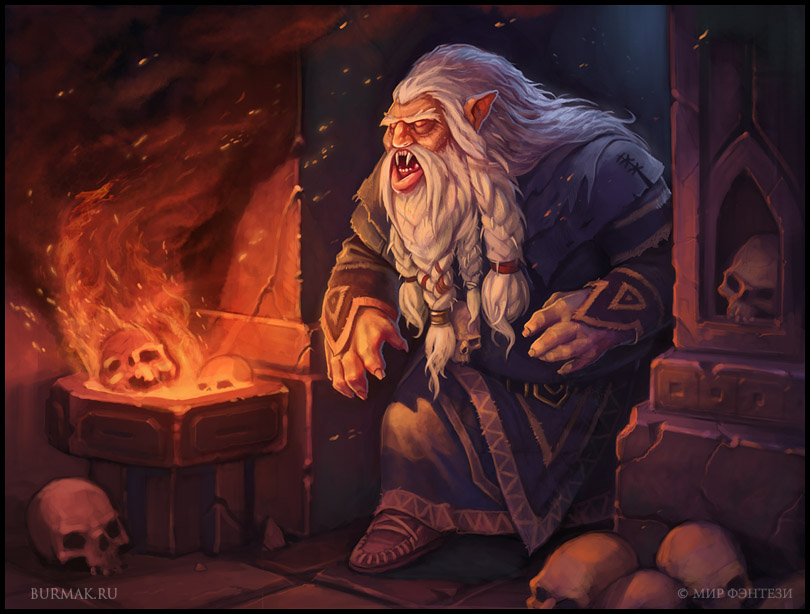
  • Dwarves use salt-rocks to distract Xorn from gemstone deposits. Too much of the salt rock causes the Xorn to become pickled, stuck and barely able to move. Cooked over magma, they make a rare treat for the dwarves
  • Legend says that if a Xorn is exposed to enough pressure, it will turn into a multi-faceted, multi-hued gem worth the sum of all the gems it ever ate
  • Miniature Xorn are said to have depopulated worlds, stripping all the heavy elements from living creatures like a disease
  • Gem stone deposits are just bellies of Xorn who have died long ago
  • Xorn settled underground long ago, spawning gnomes, dwarves, kobolds, and other underground humanoids. They are ashamed of this story and will deny it
  • Xorn are fused hermaphrodites. Each is not a trinary creature, but two creatures, one male and one female, fused, both halves of the same Xorn. 
  • Crystal, Lava, Ice, and Metal Xorn were all eaten long ago, leaving only the gemstone Xorn we know today
  • Few creatures capture the hate of a dragon more than a dwarf, and Xorn have that honor. It is said that a Xorn once wandered into Xyphnecrop's great treasure hoard and consumed his entire collection of rubies, before snacking on the gems embedded in his gross underbelly. When the dragon awoke, the Xorn was long gone, though it would be a millennial more before the laughter at his fate ceased
  • Xorn are from the elemental plane of gluttony and avarice. They have been accidentally summoned by fat and greedy sorcerers
  • Xorn were once servants of the creatures that lorded over the very dragons themselves. When their crystal palaces were struck with disaster, the creatures were knocked lose, sent throughout the planes. Those landing on the plane of elemental earth fared much better than others, sniffing out and examining any gems in the hopes that it will lead them once again to their masters and their crystal cities. They eat the gems to collect building material to bring home
  • Xorn only eat crystals, not true gems
  • Xorn are the embodiement of rage from mother earth and stone, sent up from her igneous womb to return that which was unearthed and stolen
  • Xorn attack by extracting calcium from living creatures
  • Xorn are matter shorn of manners, some of the most rude creatures in the universe
  • Xorn are forlorn creatures
  • Xorn aren't creatures, but in fact silica based plant life
  • Xorn are filled with 'Xorn pearls' various geodes harvestable upon death
  • Xorn are unable to reproduce, because they lack a soul. They steal greedy hobbit children to reproduce
  • Samishi of Sulspicc claims that Xorn are simply the larval stage of another larger creature
  • Xorn actually have four arms and legs, but are phasic creatures, the fourth arm and leg are out of phase with the rest of the prime material plane. This has the side effect of a fourth attack happening after the first attacks occur
  • The excrement of Xorn are gem-dust bricks
  • They have a motile and sessile phase.
  • Their armor reacts strongly with sugar (gulcose) dissolving rapidly
  • They are the offspring of clockwork constructs and golems
  • Xorn are in reality the plaque on the teeth of colossal demons, being shed like dandruff
  • Xorn are the bio-mechanical creatures used to make space within the hollow world. Once finished they were banished to the elemental plane of earth, a considerable act of mercy, considering it is their idea of paradise. Those that force them back into the prime material plane are sadists.
  • Xorn do not exist. They are a myth used by thieves that are very bad at disguise

Note that many of the awesome images (with attributions) came from the thread at: CGhub
http://cghub.com/forum/showthread.php?t=15500

The ecology series is a crowdsourced series of articles, and contributors can be found on google+ under the hashtag #crowdecology. They are limited posts, but following me on G+ will allow you to see them. All artwork is credited where the artist could be found. Classic ecology articles from Dragon magazine are used both for reference and inspiration; the whole impetus of the idea was to create 'classic' ecology articles that are actually useful. Let's Read the Monster Manual by Noisms is also a source of inspiration.  If you're curious how to make effective use of these articles, read On the Use of Ecology.


Hack & Slash

On the Ecology of the Wyvern

"I have it on good authority from the duke of the Puttenbergen's vizier, Jochrim ibn Oberwaldski, that the wyvern is the protean and horrendous manifestation of dwarvish gold-lust also known as the dwarrowwife." - Lujek, starter of the final wyvernwife wars

Nomenclature: Wyvern, Wyrmspawn, Dragon-birds, Whyverns, Wiverns, Scorpion dragons

Description: A bipedial winged reptile with a poisonous tail sting.

Things that are known:

  • They can fly
  • Their tails contain a poison sting
  • They are related to dragons


Rumors and other whispers in the dark:

Monster Manual Illustration

  • It's pronounced wai-vern
  • It's actually pronounced wii-vern
  • No, it's derived from the latin for viper and the "Wy" has a long 'i' sound
  • Wyvern ecologies are only written by sages who are jerks
  • Wyverns are the physical manifestations of poison, being from the elemental plane of poison, which is filled with roiling clouds and bright candy like surfaces
  • Wyverns are part of a family of creatures known as xyverns, yyverns, and zyverns organized in a complex hierarchical structure, each serving a different purpose
    • A Xyvern is almost like a wyvern, but with pteranodon wings and a confusion venom
  • Wyverns are rainbow colored monsters that emit a sonic attack that causes ecstasy. The sound is a high pitched wheezing
  • The wyvern is a chimeric creature, combined parts of a turkey, fruit bat, gecko, and scorpion. There are some who say it also possesses the forearms of a snake.
  • That's inaccurate, wyvern is a term for a giant turkey
  • Wyverns are drawn to small enclosed spaces, much like cats are drawn to baskets and boxes.
  • Wyvern tails are actually their heads, being that's where the venom is stored, and what looks like the head is just mimicry designed to fool and confuse predators.
  • Wyverns are the natural animal competitors to dragons, resistant to both breath and dragon magic. Now, however they either subsist in dragon free environments or are used as servants by those same dragons
    • Attempts to breed versions that are magically resistant so far have been a failure, but have produced a number of interesting wyvern variants
  • Wyverns are flying lions with bat wings, but have no tail, no sting, and no poison. It is a legend based on the Siege and fall of Castle Juniper in the Moon Mountains. Goblins rode wyverns flinging poison spears
  • Wyverns are inbred dragons
  • Wyverns are the cursed remains of a bird race, who must kill a certain number of sentient beings before the curse is lifted. Every wyvern carries their total secretly, hoping for the day to become free once more
  • Wyverns are the homunculi of dragon arch-wizards
  • Wyverns are the result of fairies dreaming of dragons. In their ignorance, they come out a lot like wyverns
  • Wyvern testicles and ovaries are powerful magical components. Wyvern know this and mistrust wizards
  • Wyverns are excellent mounts. If they won't cooperate when they are alive, they make excellent mounts as undead creatures also 
  • Wyverns reproduce by stealing the stings of scorpion men. This infuriates them. Many forge replacements of brass and steel and devote their lives to hunting wyverns.
  • The Wyvern is the heraldic symbol of the black hobbits of Overhill. Nobody has ever seen a wyvern in or around Overhill, but the black hobbits speak of the Wyvern in a reverent voice. "When the end times come", they say, "the winged lord will send the Wyvern to swoop us away, and Overhill will be no more."
  • Wyverns grow from the fetus of a bat magically implanted into a scorpion egg, ensconced in the egg of a snake, ensconced in the egg of a turkey, and hatched in a nest of poison ivy
  • The wyvern is the adult form of a cockatrice
  • Wyverns are actually a term locals use for agile dinosaurs
  • Wyvern eggs can feed twenty men for a day. Or ten hobbits
  • Wyvern eggs can be used to poison two hundred men. Or five greedy hobbits
  • A wyvern is not bipedal, it is actually tripodal. The third leg is presumed to be a powerful aphrodisiac
    • Wyvern poison causes death by priapism. This causes males to save versus the poison at a penalty
  • Wyverns are color blind
    • Only because wyverns have no eyes
Skythemoonwarrior

  • In the souks of Salahalabarbalhalas, the powered purple 'juice' of a wyvern is sold as a powerful cure all, antidote, and aphrodisiac. It can be snorted for a powerful high with a side effect of complete poison immunity, assuming it doesn't kill you
    • Sadly, 'wyvern juice' is made from hobbit urine and agave syrup, a horrible tasting mixture that may not do what it says on the tin
    • Actually, real 'wyvern juice' is collected by cooling the head of a wyvern to the freezing point of rock oil, and chiseling out the venom glands, producing 300 gold worth of juice. 330 gold if milked by a hobbit maiden
    • only males produce wyvern juice
  • Wyvern wings are cyclically considered the height of fashion, most recently because the queen wore one during the funeral of her husband
  • They eat their victims whole, but bones and metal aren't digested. After a kill these are vomited up near the wyvern nest
  • All wyverns are hermaphroditic
SeaAngel2133
  • Wyverns are actually giant mutant mollusks, gastropods. Their shells are contained in their stomachs.
  • Unsurprisingly they taste like chicken
  • They are helpful natural creatures, feeding only on poisonous vermin. Slaying a wyvern does irreparable harm to local communities
  • Wyverns are temporal tesseract creatures. i.e., there is only one Wyvern but instead of being distributed amongst the manifold universes, they manifest everywhere. Part of the reason of their chimeric appearance is that changes in physical representation also bleed across the manifolds. If you manage to find the ur-Wyvern and kill it in all the universes at the same time, you will get rid of wyverns. Otherwise they will continue to spring into existence evermore. Don't be surprised if a wyvern remembers you the first time you meet it.
  • Wyverns are endangered creatures that are too ugly to live. They are so ugly, that if a wyvern sees its reflection in a mirror, it will flee
    • This information comes from Aphandor, the famous explorer, who was killed by a wyvern and eaten while wearing four-mirror armor
Apsaravis
  • Wyverns are a cross between magpies and turkeys, a terrifying bird without fear, that likes mirrors, shiny objects, and gems
  • Wyverns have no soul
    • Five souls. Wyverns have five souls. They are twisted, suffering, and blinded souls, but for every one banished, the wyvern will lose the properties of that soul
    • This means undead wyverns are practically unturnable, being that they count as five undead. Luckily it's five times as hard to created undead wyverns
  • When wyvern wives whisper wonderful whimsical wild-tales witches wish warlocks would woo them
  • When a witch and warlock mate, a duck will give birth to a wyvern
  • People stung by a wyvern and resurrected have said that they died in bliss
  • Using wyvern dung instead of bat guano for a fireball instead created an exploding acidic sphere
    • Wyvern guano in general is a useful ingredient for incendiaries, acid vials, and cart bombs
  • Wyverns are the angels of the goddess of Pleasure and Poison, Whyt. Wyvern venom is one of the most pleasurable experiences imaginable and many an adventurer is a secret YV addict. Actual deaths from wyvern venom are caused by the overdose burning out all the nerve endings, resulting in a comatose, hebephrenic husk of a being
    • Priests of Whyt turn into wyverns over time by replacing their body parts with animal grafts. The wyvern's brain as such is human in nature, but beyond the acuity of actually spell casting
Brightcat13527
  • In cyrilics a wyvern is written as ŃƒŠøŠ²ŃŃ€ŃŠ½ and is believed to be the forerunner of the hut of Baba Jaga
  • The city of Nrevyw (Nur-ay-vee, rhymes with gravy)is very adamant in it's claim that the name being reverse for Wyvern is nothing but a coincidence, but since the scroll of independence from the king's rule spells out the city's name like that there is a strong reluctance to change the name and lose said independence
    • It doesn't  help that the city walls are home to a nest of 144 wyverns that never attack the city itself though. In fact, nobody ever saw the wyverns do anything other than fly around as long as they're unprovoked
    • The Wyte Guard of Nrevyw wears wyvern-wing cloaks
  • A wyvern transplant is never rejected by the host body, and always naturally grafts to any creature to which it is attached.
Drakhenliche

  • Wyvern bile and cerebrospinal fluid stop troll regeneration
  • Repeatedly asking a wyvern "why?" will cause it to storm off in disgust
  • Wyvern poison is used as bitters in dwarven cocktails (like stormy stout)
  • At night, wyverns transform into beautiful dwarven maidens
    • Well, not exactly. Wyverns are dwarven females, and the dwarves greatest shame. They are never encountered because they are kept hidden away. The dwarves of Kamolovarupa keep them chained and massaged by drone dwarves to continually produce new little dwarves
    • Mating with wyverns is unpleasant, which is why dwarves drink so much, and why the sting causes priapism and arousal
    • Mentioning this fact is a good way to have a dwarf kingdom go to war with you
    • Wyverns are always hidden behind elaborate stone walls and floorboards
  • Wyverns shed their wings annual, growing a more elaborate pair every year
Eterna2
  • You can determine the age of a wyvern by counting scale segments
  • A wyvern has three cloacas. One for solids, one for liquids, and one for gasses
  • Wyvern gas has a weakening effect, used as an experimental sedative at the Barovia Strahd Asylum
  • Very old wyverns are very large and can no longer fly, making them popular sport for hobbits
  • A wyvern is heraldry come to rampant and perilous life. It manifests as a vast winged shadow, with talons and stings and filled with fear of open spaces. It is a protean creature of shifting parts
  • In its youth, a wyvern is quite intelligent. They can be bargained with and sometimes even made to keep their word, but with the insane pain from molting and growing new wings, their sanity wanes
  • A wyvern is a cognate of viper, an insane poisonous snake grown beyond all reckoning.
  • A wyvern is the promise of an unknown monster, constantly morphing and changing forms. Its chimeric form is just a metaphor
  • The Keeper of the Seven Seals keeps Seventeen Sea-wyverns in his ornamental Oy!-pond
    • An oy pond is a more dangerous version of a koi pond
  • Wyverns steal limbs from Heraldic Dragons for their adolescents' grafting experiments. Thus the legless Amphiptere, the wingless Wyrm
  • Wyverns are trying to turn themselves into pompous four-legged dragons
  • Wyverns are building some gigantic ur-horror composed only of claws, horns and leathery wings
  • Dragons are mutable creatures and obsessed with eugenics. They curse all their not-quite-dragon spawn with distinctive, baleful powers and weaknesses to insure they are not classified as true dragons. They bane of wyvernage is saved for the worst: Those that talk back and won't eat their villagers 
  • Wyverns were once sea serpents. When the triton community undertook major prayer, fasting, and sacrifice, their plea culminated with a quest. Their goddess took pity on them and cursed wyverns with wings, so they could only haunt the world above the waves from then on. This was cause for feuding between the coastal kingdom and their undersea neighbors
  • Wyvern were first created as draconic bonsai; an academy of powerful wizards had a tithe of dragon eggs come to them every decade from subdued dragons, and they had competitions to see who could make the most interesting protodraconic form. They have a LOT to answer for, in the draconic-monster-infested world
  • Wyverns first arrived as parasites on the hides of vast space whales
  • Wyverns are battle suits for small translucent rodents like hamsters. One eye pushes back, and they follow the corridor to the skull "bridge." An orc warlord came to know this secret, and nearly conquered the world before being burned down; so far, no one else knows the secret, but they DO know that old Scraglatchiar the Conqueror left the secret of his success carved on a wyvern skull hidden with his treasure, and orcs have never stopped looking for it 
  • When the world was still cooling, the King of the Faerie gambled with one of the first dragons. The dragon lost his arms, his magic, his cleverness, and his magnificent breath; the Queen interrupted the game, and spotted the dragon a poison tail loaded with fey-killing venom. The King of the Faerie lost interest in the game (and the inevitable revelation he was cheating) and the crippled dragon (named wyvern) re-entered the world in shame
  • They all come from a cursed mirror being broken in the grove of a mad druid. The results of removing this curse from an individual wyvern are unknown. Would it become broken glass? Or several other monstrous creatures and elementals
  • Wyverns are the keepers of all knowledge, the words of lore written upon their scales in the ancient language of serpents (h/t to Zak)
  • Wyverns do not breath, nor do they have lungs. They absorb air their their membranous wings, spending most of their time high in the jet stream
  • The wyvern has no legs, only arms and wings
  • They are the flip side to a stirge, a beast created to extract. Wyverns were made to inject
  • They compete in the ecological niche of eagles, but being featherless are immune to the parasites that plague those large birds
  • Wyverns try to bite off each others tails before mating, their eggs will hatch before the tail grows back
  • Corkmelon is used to disable the sting of a wyvern, making it safer to trap them in nets. Slashing their wings helps also

Combat Techniques

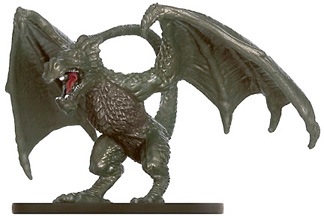
Roar, get out the way! (WotC Miniature)
The Tail Spear: A wyvern can grapple an opponent with it's mouth, doing normal bite damage, and then fling that opponent up in the air. Once airborn, they then strike impaling the creature on their tail. If they successfully bite, grapple, and then throw (bull-rush) their opponent, their tail strikes with a +4 to hit and the target saves versus poison at -2. This exposes the wyvern to a variet of attacks, and all opponents get a +4 to hit the wyvern for 1 round.
The Flying Strike: Wyverns fly down to their opponent, stabbing them with their tail, and then trampling them on the ground. They must charge their opponents with an Arial dive. Once in range they attempt to strike with their tails. Hit or miss, they then attempt to over-run their opponent. On a successful overrun the opponent is trampled and takes 1d4 hit points of damage per hit die of the dragon.
The Wing Buffet: A single target standing on the flank of an enraged wyvern can be buffeted with a wing. If hit, they take 1d4 damage and must make a save versus paralyzation (Fortitude or Reflex, DC 18 (10 + 1/2 Wyverns Hit Die + Strength Modifier)) or be knocked prone. It may do this in addition to it's normal attack

Wyvern variations

Two-tail pygmy wyvern has a poison, which if survived will cure any ill. This permanently makes you less healthy, but can be used to save your life. The problem is, a single sting can kill, and they generally attempt to stab you with both tails
Undead wyverns (skeletal and zombie) are easy to create, considering the number of creatures souls used in their formation
Great wyverns have grown to the proportions of the largest dragons. No longer able to fly, they can spit the acidic poison from their mouths

What is the difference between a dragon, drake, wyrm, and wyvern?

Whatever you want it to be. Traditionally however, dragons are organized via color. Chromatics for evil dragons, metallics for good dragons, and gemstones for neutral dragons. Most terrain oriented dragons (shadow, lava, etc.) are closer to monstrous drakes, though may usually be assumed to be evil. Drakes are very similar to dragons, though usually bestial, not being able to speak, cast spells, or reason. Wyverns have only four limbs (two wings and two legs) and have poison stings. Wyrms are reptilian beasts that have non-functioning, absent, or vestigial wings. Linnorms are a specific type of wyrm that can fly in spite of not having wings, related to dragons, being a much more primitive, aggressive, barbaric, and greedy version. They have a venomous bite.

In the end, they are all just words for the same thing


The ecology series is a crowdsourced series of articles, and contributors can be found on google+ under the hashtag #crowdecology. They are limited posts, but following me on G+ will allow you to see them. All artwork is credited where the artist could be found. Classic ecology articles from Dragon magazine are used both for reference and inspiration; the whole impetus of the idea was to create 'classic' ecology articles that are actually useful. Let's Read the Monster Manual by Noisms is also a source of inspiration.  If you're curious how to make effective use of these articles, read On the Use of Ecology.

Hack & Slash

On the Ecology of the Vampire

"Listen to them. Children of the night. What music they make." - Dracula

Nomenclature: Vampires, Leeches, Licks, Bloodsuckers, Overbite, Fanger, Fangs, Lonely Ones

Description: Undead creatures that feed on humans

Things that are known:

  • They are repulsed by mirrors and garlic
  • Sunlight damages them
  • They can be slain by being held under running water
  • A wooden shaft through the heart will paralyze them
  • They are resistant to non-magical weapons
  • Once 'killed' by normal means, they simply turn into gas and retreat to their coffin


Rumors and other whispers in the dark:

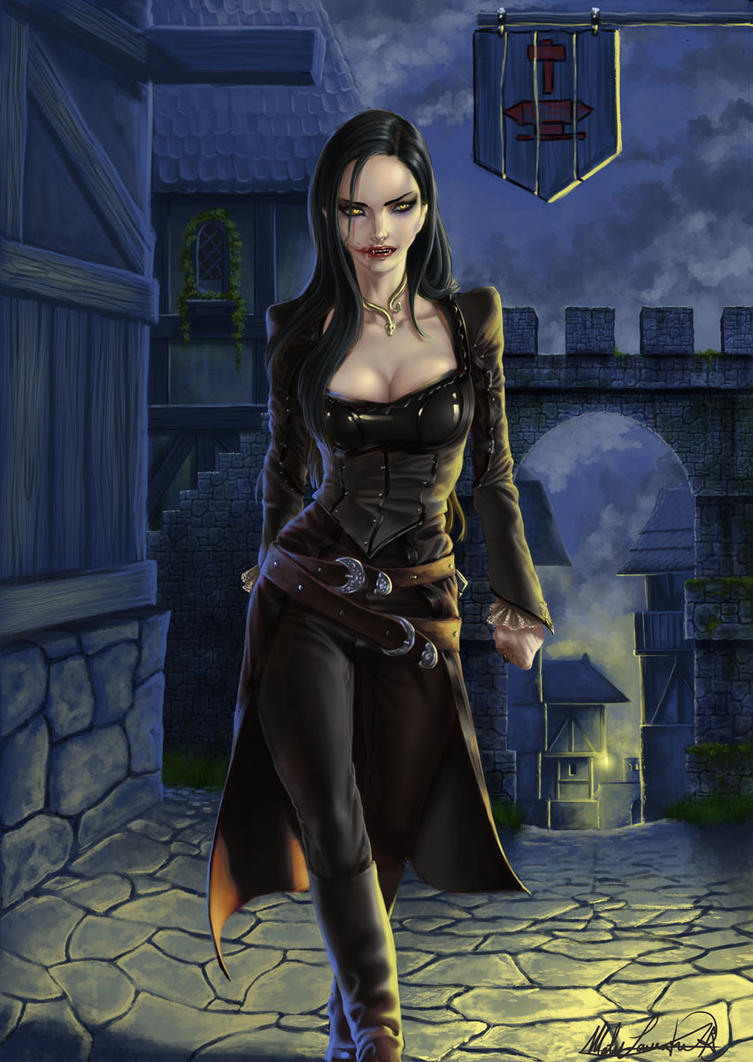
  • Not undead creatures, they are actually intestinal parasites that infect corpses. The victims harbor all sorts of weird physical characteristics, but the actual creature is a small, wandering, gut worm. The gaseous form trick is pure parlor magic, just a common flashbang that allows the worm to escape.
  • They are a tactic of the powers of Law to isolate and neutralize dangerous Chaotic influences.  Vampirism is very attractive to a certain kind of power-mad maniac.  Immortality and power.  And the cost?  Ha!
    • But what happens when a dangerously dynamic champion of Chaos becomes vampire?  By the nature of the curse, they are tied down, they are dependent on their environment, they are bound by day and night, they are beyond life, and can no longer learn and grow (ie gain levels).  They have stopped being a dynamic threat, and become a static irritant - they have been encased in a cyst which protects the larger world from their influence.  Perhaps they pollute a small corner of it, but they are effectively neutralized as champions of Chaos. 
    • Vampires become terrible forces for conservatism.  Unchanging.  Eternal.  They are Law's way of making Chaos serve it, and only we poor mortals suffer for their gambit.
  • They don't actually exist. They are just the fiction-made-manifest of a sage who writes pot-boilers in his spare time. Unfortunately the one with the vampires was written in a magic book, which causes anything within it to become real, as if it had always been real. The book "Vampyr" series is quite popular. Destroying the book causes all vampires to cease to exist as if they never existed at all. Which they didn't.
  • Seven vampires carry the throne of the underworld goddess, she sends them to promote suffering in the world and remind us of her wrath. 
MatesLaurentiu
  • A spirit of the underworld possesses the corpse, making a mockery of the victim, corrupting and exterminating the departed soul. Once slain, it is banished until it can regather its power. Each devil or demon can have one such champion in the world at a time. 
  • Werewolf corpses make particularly good hosts for vampires.
  • They are all sludge vampires.
  • Vampires are just ghouls, though those that feed on immortal flesh. The powers of the vampire are just side effects from their diet
  • Vampires are a trick your mind plays on you to cover up its own secret workings. Every time you think you're fighting a vampire you're actually fighting something else you don't want to look at. And if you have a sufficiently powerful personality you can get others to share your delusion, blaming the "vampire" for crimes nobody wants to confess. The mythology of the vampire gets more baroque the more crimes it must stretch over. 
  • Vampires are part of an infection - a humanoid infection. They are a hive mind, a single viral organism that infects itself out from a source. The source is nearly immortal, the ones it infects are quite strong. Those that the infected infect are pale shadows of thinking creatures.
  • Vampires are a fictional cover for the lizard overlords.
  • The blood that vampires drink is sent directly to hell. Not only does this make your soul more likely to go there after you die, but the genetic material in it (call it essence if you want) is mixed and used as a starting compound for building demons.
  • Vampires are the ultimate narcissists and for this reason they have never united to rule the world. They only "reproduce" when a vampire is foolish enough to think they can create and control another vampire, who almost always manages to get away when their own hyper-narcissism kicks in. If one vampire seems to dominate another it is a sure bet that the "slave" is merely trying to get close for the ultimate betrayal. Thus the whole idea of vampire families, splat-sects, etc. is a paranoid fever dream of Churchly witch hunter manual writers. Vampires are solo monsters, powerful enough, but their own worst enemy.
  • The Vampire is even worse than the most terrifying nightmare. It is an idea that takes over the mind, inducing secrecy and obsession. People infected with the idea, find themselves engaged in absent-minded bloodletting. Left unchecked, they begin filling bowls, barrels, and other containers with blood. It is unclear what their purpose is, and they are always unaware of their actions.
  • They are the guardians of the debts incurred by wishes. Wishes always have a cost. If that cost remains unpaid, a creature extracts the balance. A vampire preys on children, stealing into their rooms, in recompense for that other annual housebreaker with all the gewgaws. The only way to stop them, is to stop the debt.
  • All vampires are actually simulacra. A plasmic being infects and replaces a body's cells. Eventually the entire being is replaced on a cellular level, and it gains a consciousness that matches that dictated by the brain it has replaced.  The vampire has no idea that its real identity is already dead. The soul is truly gone. 
    • These plasmic beings have a cellular structure that cannot stand up to the rigors of UV light. Other weaknesses are attributed to superstitions of the former identity. 
  • The specific powers and limitations of a vampire are linked to the qualities and lifestyle of the host spirit. The landed elite are tied to their home of origin, their pale skin no longer tolerates the sun, and their thin noble blood reacts to garlic (a natural blood thinner) poorly. Poor vagabonds, by comparison, suffer constant wanderlust, are empowered by the sun and road, and resist the elements (including elemental spells). While frequently not as traditionally powerful as their noble kin, the rest of the spectrum of vampirism is aided by a shroud of ignorance.
  • Vampires are simply young liches, struggling to hold on to the vestiges of life. The blood brings the semblance of life. As the years progress, it takes more and more blood for the same effect. As the lich slips into the embrace of undeath, his need for humanity fades away, along with the taste of blood.
  • Wishes and other magical immortality means always produce vampirism.
  • If you refer to them as Draculas they will spare you.


The ecology series is a crowdsourced series of articles, and contributors can be found on google+ under the hashtag #crowdecology. They are limited posts, but following me on G+ will allow you to see them. All artwork is credited where the artist could be found. Classic ecology articles from Dragon magazine are used both for reference and inspiration; the whole impetus of the idea was to create 'classic' ecology articles that are actually useful. Let's Read the Monster Manual by Noisms is also a source of inspiration.  If you're curious how to make effective use of these articles, read On the Use of Ecology.

On the Ecology of the Unicorn

"Unicorns aren't real. And if they were, they'd kill you" - apocryphal

Nomenclature: Unicorns, Holy Steeds,

Description: Pure white horses with a single horn atop their head.

Things that are known:

  • They are always white
  • They have horns
  • They are known to shift through space
  • They are immune to charms and enchantments
  • They are susceptible to the charms of young women


Rumors and other whispers in the dark:

  • Unicorns gain their power from the chaste and pure of heart. The bond they form with a holy individual, such as a virgin or paladin is for life
    • However if they should succumb to sex or sin, the unicorn becomes mad with rage. It looses it's horn, its hair turns black, its hooves burn with hatred, and it hungers for flesh, becoming a nightmare.
  • Unicorns are a special type of fairy shapeshifter, that can only reproduce with virgins. They gain their trust and intimacy, often by playing hard to get, and then bed them, consensually or not.
  • It is as it says, the unicorns need maiden riders. This is wondrous when it begins, but once bonded from the unicorn, they are separated from the realm of man. Tending constantly to the needs of another fickle creature, loneliness, and the need to hunt evil begin to wear. The youth given to the maiden rider from the unicorn begins to become a heavier and heavier weight every year. Eventually the riders become hostile, bitter, and weary.
  • A unicorn is a dream of instability and madness, more powerful then you and completely unpredictable. 
  • Unicorns are warlike fey, sustained by bloodshed, righteous fury, and fanatical zeal.
  • Their alliances with paladins are not out of a desire for justice, but merely made as the most expedient way to shed the blood of the guilty.
  • Some Unicorns are even said to use their allies to not only create warlike churches of justice, but also nests of evil creatures, to ensure that there will always be vengeance to be had.
  • Unicorns are pre-pubescent centaurs. They are only into virgins until they undergo puberty, a rather traumatic metamorphosis involving a great deal of wine drinking and celebration in lost and hidden caves. 
    • There is a rumor that their centaur torso is the torso of the one virgin they eventually deflower, but it is much more likely that bacchus himself shapes their form.
  • Unicorns are the dreams of virgins seeking aid, their desire to escape giving form to spirits in the wild. They exist beyond the call, but cannot properly breed. Such a breeding of Unicorns might be possible, but has yet to be accomplished.
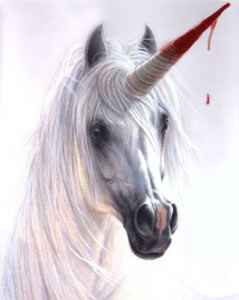
  • Unicorns must drench their horn in the blood of a pure maiden, once a year or their powers are lost.
  • A true unicorn horn is pure platinum. That's why they are no longer found. Bone horns come from fish. Any new sightings are either lies or a sure sign of an invasion.
  • Unicorns don't need virgins, so much as they need women who have rejected men. 
  • The unicorns are horses, infected with a brain worm. This worm spends its first life stage as an egg in the soil of a cemetery, but once hatched it crawls up on the tallest blade of grass it can find and lies in wait hoping to be swallowed by a suitably large herbivore. Most herbivores know this and will not willingly feed in a cemetery, but horses can sometimes be led there and forced to feed by unknowing masters.
    • Once eaten, the worm lodges itself in the brain. It develops a large horny proboscis which protrudes from the hosts forehead
    • It needs a human brain, and one filled with zeal, preferably laced with innocence and suppressed desires. Thus, it will be drawn to virgins and paladins. It will remain with its intended next host, testing it to see if its brain will be a truly delectable treat and its body a suitable host, all the while using its rather powerful psychic abilities to create suitable chaos and danger.
    • Once the host is found suitable, the fabled "horn" will be used for its intended purpose, leaving the horse body vacant and dead and the new host body almost intact apart from a ruptured ear canal. The creature will now revel in the last and shortest stage in its life by influencing its new host to abandon all former principles and fall to hedonism and debauchery (coincidentally the unicorn will be gone at this point, furthering the theory that unicorns will abandon unworthy masters). Soon, the host will meet his or her fate somehow, at the hands of the law or through an act of despair, and will be buried in a nearby cemetery, its brain case ripe with eggs...
  • The souls of great saints become angels. That is a fate out of reach of the nice lady down at the corner market. Occasionally, however, their wishes will find a place upon death, becoming a brilliant white horn on the forehead of a stallion or mare. The horse then seeks others who remind them of the horn giver, pure and compassionate.
  • Just as clerics channel the power of their god into Prime, so does the unicorn channel cosmic power. The horn is an intricate multi-dimensional array that reflexively converts power. This makes it very sensitive to auras and vibrations from intent and mindset. The presence of intense selfishness or delight in pain causes feedback that stings in the unicorn's bones.
  • Salvressa Greengoat was a powerful druid who was mocked by wizards. They claimed they could weaponize animals to serve them in destroying their foes, and she could only use them "out of the box" as it were.
    • She decided to prove them wrong. She thought of the most painful experience she had ever had, and she decided to incarnate it. She remembered the penetration and disillusionment of her first sexual experience, and she projected it out into a steed.
    • First, the light and the cuddling and the freshness of idealism. Then the puncturing, and the pain as a construct of what romantic love is contrasts with the rutting and grunting and abandonment of mating. The piercing pain, physical and emotional. And she unleashed it on the world. 
    • Salvressa Greengoat was never famous for her monster making (and this was her only attempt.)
  • Voskohr the Defenestrator is an evil lich with a thousand windows in his multi-dimensional tower. The only way in is to insert a unicorn horn into the door lock, and each horn only works once. He figures if someone wants an audience with him, they had best be prepared to slaughter something pure to even get a foot in the door.
  • Drunk fey at revels decided they would do away with the rider as they imitated jousts the humans hosted. They put the lances directly on the horses. It did not work out. Surviving unicorns became disapproving icons of probity and virtue, considering themselves object lessons in the pitfalls of drunken animal-tampering.
  • The unicorns horn isn't horn. It's actually pure magical energy. It's why the horse is white and so difficult to hit, the energy repels nearby materials. 
  • For that matter, the unicorn isn't an actual horse. It's just magical forces, swirls and whorls of energy, and shapes more strange that all float together in the approximate shape of a horse. The body is like the tail of a coat, dragging along the ground.
  •  The Thickwood is impossible to navigate, intentionally. Brambles coat everything, climbing trees and spreading across the ground. They release fog that eats firelight. The only way through is to follow the glimmer of a unicorn's coat, and the shine of the light its horn projects. They were created as guides to carry the allies of the fey through the darkness.
    • When the Thickwood was destroyed and the ground it once covered was salted and burned, surviving unicorns were faced with a crisis of purpose. They decided to take their role as guides metaphorically, and they sought out those hemmed in and befogged and led them to clarity and safety.
  • A unicorn's bones are stitched with sigils that collect and concentrate emotions--namely righteous wrath and compassion. The horn is capable of either directing a release of pent-up energy, or conducting a tracery of a multi-dimensional glyph that gives form to those energies.
  • Orcus had a phalanx of wicked goat mounts, shaggy and topped with skirling cathedrals of bone horns. A few of these defected one of the many times Orcus was (temporarily) slain. Their new patron, a forest goddess, fused and straightened their horns and granted them light and grace. They are intense rivals with their former kin.
    • An entire cult of Orcus, the Crooks, has as its purpose the ambition of discovering whether a hybrid of unicorns and devil-goats will yield something useful to their master. So far, no success staging experiments; unicorns can apparently die at will.
  • The horn of a unicorn can cure any disease. It may also infect you with parasites that have odd effects. 
  • Each unicorn has glyphs inlaid in its horn that reveal a prophecy uttered by their divine patron. These can only be read after the horn is separated from the unicorn and given special treatment--unless the diviner has a healthy dollop of fey blood and the approval of the sponsoring god.
  • The city state of Belleraes has some really weird morality laws involving sex out of wedlock and legal marrying age. Many a visitor has fallen afoul of their castrating carpet-knives and twisted legal system. This culture was shaped by about five centuries of a fad among the nobility. Every legitimate noble had to have unicorn decorations, and at least once a year eat the meat of unicorns.
    • Every part of the unicorn was used; bones for end tables and writing desk inlay, hair for pillows and helm crests, eyes dipped in glass and inserted in statues or head trophies, hide for clothes or upholstering loveseats, marrow for Virtuous Salsa, and so on.
    • Unicorns have been out of style for at least three hundred years, but laws passed to ensure virtue and virgins are still on the books and existed long enough to shape this society indelibly.
  • Unicorns focus on virgins because "purity" is the same as "unmixed." They need naivety, people whose ideas have not been challenged and shaped by conflict with other ideas. They need spirits that have not deeply twined with other spirits. They are avatars of loneliness, colorless and solitary. Compromise is their poison.
    • Because of this, their minds project a flickering "horn" of singularity that can penetrate anything.
Special Unicorn Attacks
  • Horn Parry: The unicorn may make a saving throw versus petrification when it charges. On a successful save, it is able to deflect any weapon set against a charge.
  • Rear up: The unicorn can forgo an attack with its horn, and instead rise up on it's hind legs to attack with its hooves. The attack does normal damage but if both hit, an extra 2-12 damage is done and the target must save versus petrification or be knocked prone. 


The ecology series is a crowdsourced series of articles, and contributors can be found on google+ under the hashtag #crowdecology. They are limited posts, but following me on G+ will allow you to see them. All artwork is credited where the artist could be found. Classic ecology articles from Dragon magazine are used both for reference and inspiration; the whole impetus of the idea was to create 'classic' ecology articles that are actually useful. Let's Read the Monster Manual by Noisms is also a source of inspiration.  If you're curious how to make effective use of these articles, read On the Use of Ecology.

On the Ecology of the Troll

"You should kill them, then burn them, or boil them. The sword is never enough" - Huyiz, the one armed mage

Nomenclature: Troll, Rubberbeast, Underbridge ogre, Trollteri,

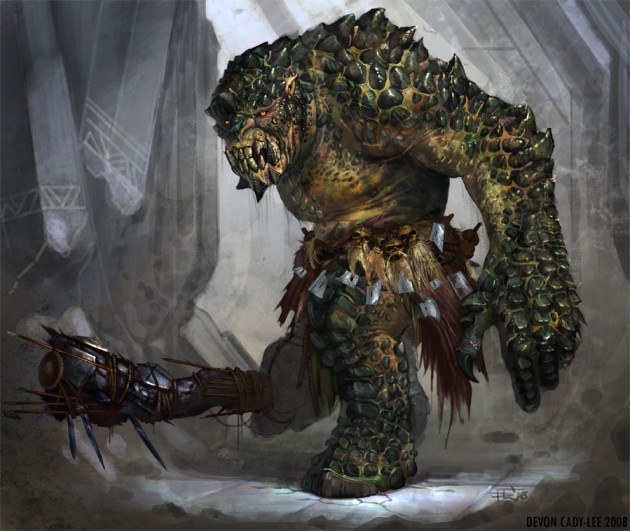
Description: Ugly regenerating monsters

Things that are known:

  • Trolls regenerate damage that isn't caused by fire or acid
  • They are hungry


Rumors and other whispers in the dark:

  • There is only one troll. Every time he is cut, he grows
  • Trolls are always ugly. They may be weak or nice, but never fail to carry a hideous visage
  • The trollplauge is what it is called when trolls realize, each part, begets a whole
  • They are magic, taken physical form. Their nature makes them cause harm or damage to living creatures. They are often the detritus from a spell designed to harm other creatures
  • This means that they are not vulnerable to fire and acid, but are instead vulnerable to the type of harmful spell that was used in their creation. It just happens that this is often fire and acid
  • Trolls are the byproduct of a wizard successfully extracting an immortalized cell line from a swamp giant. After testing and experimenting on the cells, it languished in a sealed beaker in an abandoned laboratory for hundreds of years. Found, it was imbibed as a potion, and rapidly caused the line of trolls we know today
  • Beware the limb replacers. Though having a severed limb replaced with a magical replacement or a wonder of mechanical engineering, troll limbs attach readily and are much more affordable and simple then whatever you are likely paying for
  • Severed troll parts that are prevented from reattaching to the original grow into a clone of the original. They share a telepathic bond
  • Healing potions don't use troll blood in their manufacture. They are troll blood
  • Troll regeneration is a byproduct of their fecundity. They are heavily influenced by their environment, taking on aspects of the terrain and creatures near where they live
  • Original trolls were a cross between fey and the earth creatures, both noble dwarven and base goblin. But some worshiped chaos and evil and gained the dark art of regeneration from a demon lord, it caused their hunger to grow, until their hunger drove them to cannibalism, and anthrophagy. The brain prions drove them mad, and they wiped out the non-chaos worshipers. The most pure of the troll vanished first, perhaps they were somehow spared
  • The mad wizard Rolleg cut the hands and feet off trolls and linked their stumps together to create a living fence. Anyone can apply this technique; simply hold the stumps together until they fuse. Collars or muzzles must be applied to prevent them from chewing off their own body parts
  • Trolls are reflections of the attitudes directed to them. Most people react with horror at their visage, so are immediately attacked. If greeted warmly, they are kind and playful
  • Trolls are vicious thieves, and their very presence causes food to spoil.
  • Frozen troll chunks buried in the enemies fields is a nice surprise for farmers in the morning
  • Trolls are the acne of young, evil treants: twisted branches that just need to come off right now. This is why trolls are gnarled in shape and often covered in moss
  • Trolls are just normal giants that are spellcasters such as shamans and witch doctors. Their coloration and skin comes from the plants they use to connect with the natural enviornment
  • Trolls would be immortal, if not for cancer. Tearing out growths and polyps and ganglions with their teeth, births new trolls. In some cases trolls burst from the mother and immediately set to fighting. Young trolls hide, spying on older ones, moving closer and closer until admitted into the clan. Some never adjust and live apart
  • Lord Agamazar broke the defenders of Castle Vizgrom by chopping parts off of captive trolls and shooting them into the town with catapults. Unfortunately, Agamazar was torn to bits by enraged trolls later that day, so his victory came with a steep price.
  • Trolls aren't natural creatures, they are the result of a series of flawed magical rings of regeneration cursed into being long ago. They were all used or sold and the enchantment breeds true
  • When reflected in a mirror, a troll is a startlingly beautiful humanoid. If pulled through the looking glass, they will trade places with the ugly one. In every other way, they are identical, including outlook, alignment, and disposition
  • Some trolls divine the future in entrails, using their own and stuffing them back in the hole before they close
  • Fire and acid don't actually kill a troll; they merely send pieces of the creature to another plane of existence. Once the entire creature has been transported, it lives on in the other plane. And on those other planes, other types of attack may be needed to send them on to yet another plane
  • Aristocrats frequently swallow severed troll fingers as a macabre form of dietary control. Don't trust the ones sold by your average village apothecary, though. Those are usually just shaved baby rats
  • Trolls are the discarded mucus and wax of Orcus, constantly refreshed by the ethereal transmission of more material from the demon's orfices. The only way to stop the regeneration is to slay Orcus, or at least convince him to be more hygienic
  • The technique of hulling trolls is quite well known, but some mad kings have taken this a step further, and begun the sexy new field of troll sculpture. Futurists predict someday the next step will be troll architecture  
  • Trolls are the essential animated cancerous essence of the Mother of Life. As such, all trolls are female and parthenogenetic.
  • Troll women are astoundingly beautiful, sometimes called dryads or nymphs, whereas trolls are large and brootish
  • Trolls are the counterpart to elves and dwarves, however instead of representing the spirits of youth and magic or earth and greed, trolls represent the spirit of the dead
  • Trolls can only regenerate in the dark. In fact, they need to regenerate constantly to simply stay alive, since their bodies are so unstable. That's why they turn into stone in the daylight.
  • Trollism is a virus, similar to vampirism, which lives in the blood of infected creatures. A creature that injects the blood of a troll may become a troll itself
  • So long as trolls drink and eat enough mortal (non-troll) flesh they retain the native intelligence and appearance of that race. Trolls exiled from troll society into the wilderness slowly decay into their vicious, wild form over a period of weeks or months
  • Trolls have difficulty thinking, but some environments (such as cold, or the dark) can make the troll more intelligent
  • Trolls and vampires have been locked in a secret war for the flesh and blood of mankind for millennia, for they were spawned by twin demon queens and hate each other with a deathly passion.
  • Trolls are something people become because of their spiritual health. That's why they have language and not culture
  • Trolls are fond of contests where the losers head is ripped off and a new one regrown. However something is frequently lost in the process although the trolls that have had their heads removed are hard pressed to recall what it is
  • The high trolls are usually referred to as "trulies", for they believe themselves truly blessed - possessed of immortality, eternal youth, beauty, vigor and regeneration ... and an aversion to sunlight.
  • Vampires are the blood-poisoned hosts of water and burn up in the sunlight. Trolls are the blood-poisoned hosts of air and turn to rock in the sunlight
  • The accursed royal blood of the Night Elemental Lord Agalloch tainted the heroes that slew him when he bid to take over the Prime MateriĆ©l. One was tainted by the essence of wind and air, turning to stone in the sunlight and becoming the first of the troll kind. The second was tainted by the essence of water and vital fluid, turning to fire and ash in the sunlight and becoming the first of the vampires. The third was tainted by the essence of earth and stone, vaporizing into thin air when exposed to sunlight and becoming the first of the stonewalkers. The fourth was tainted by the essence of fire and flame, liquefying into a puddle of fetid water in the sunlight and becoming the first of the nightmares.
  • Werewolves and lycanthropes are loathed by all the bearers of the elemental blood curse, for their blood is infused with the essence of the moon and stars, giving them greater power when in moonlight, but no drawbacks in sunlight. The lycanthropes are truly the children of Orion the Hunter, born to hunt the blood cursed and keep the lands of the Prime MateriĆ©l safe for mortals and their works.
  • Trolls were once peaceful, but asked the fae queen for a boon of immortality. It was granted, allowing them to draw from the life force of any thing they ate. Soon those traits began to affect the trolls, as they became dumber and more cow-like, they realized their error and changed their diet. Now they seek out the most intelligent and aggressive creatures they can find, though this has done little for their relations with other races
Combat Techniques:

  • The Betrayal: Trolls will often dig deep pits in their lairs and happily dive into victims and pull them in, both falling to the bottom. The damage from the fall is little worry for the troll
  • The Division: Trolls have been known to detach a limb and throw it behind its victims. This prevents the troll from rending its opponents, but the limb receives a separate attack used to trip the party member (on a successful hit made at -4 for being prone, the target must save versus paralyzation minus the damage dealt or be pulled prone)
  • The Improvised Weapon: Trolls like to grab creatures two size categories smaller than them and wield them as weapons. A medium troll does 1d4+5 with a tiny creature, A large troll does 1d6+5 with a small creature, and a huge troll does 2d6+10 with a medium creature. If you have a gargantuan troll, you probably have more serious problems (it does 3d10+15 with a large creature) The damage applies to both the victim and the weapon of course

There are many variations of trolls, rock, ice, swamp, etc. These specifications do not grant them elemental powers or resistances, but indicate differences in size, intelligence, and culture. They frequently receive bonuses in the terrain.

The ecology series is a crowdsourced series of articles, and contributors can be found on google+ under the hashtag #crowdecology. They are limited posts, but following me on G+ will allow you to see them. All artwork is credited where the artist could be found. Classic ecology articles from Dragon magazine are used both for reference and inspiration; the whole impetus of the idea was to create 'classic' ecology articles that are actually useful. Let's Read the Monster Manual by Noisms is also a source of inspiration.  If you're curious how to make effective use of these articles, read On the Use of Ecology.