Tampilkan postingan dengan label death. Tampilkan semua postingan

On Death and Dying in Dungeons & Dragons

These vultures surely do not represent players!
I'd be sure to tell them, you know?

I'm a fan of communicating information before-hand, because I never want to have a conversation that a player starts by saying "Well, my character would have known beforehand. . ." because they are likely right.

Who likes to lose an argument? Not this guy!

However, the players won't have the information about the below, they will have only information about the effects.

In addition, I'm not submitting the following article for perusal because I have any sort of moral platform against the desecration of the dead. I mean, if the players want to loot their dead companion and leave his body in the dungeon, that's ok!

I think it is a pretty fantastic fantasy world that we are imagining here, and that it might be made better if we stopped thinking so scientifically about it.

What happens at death?

At the moment of death, the soul of the player is immediately trapped within their body. They are trapped within their body, for the many, many, hours it takes their body to truly, fully, die. However, they are separated from all the influences that have made them who they were in life. They remain in their corpse in their most pure and ideal form, consisting of nothing but oceans of emotion and thought.

Of course they are exposed to the endless winds of the far realm.

No longer feeling the bond they once felt with their companions, they remain aware of all that transpires around them. If this activity is heinous enough, it will reinvigorate their bond with the prime, and they will not be able to pass on, eventually becoming undead. Certain awkward passions, such as hungering for human flesh, or the torture and molestations of innocents will also cause this bond to be strengthened. So will being forced ahead of the party at sword-point

The only way to insure the passage of the soul from the material, is to expose it to comfort. A funeral, wake, ceremony of some kind comforts the raw spirit, and it passes on, knowing that nothing is left for it to do.

What happens when we loot the body?

1. The body or spirit rises as an undead. The undead that is created has no relation to the hit die of the deceased. The abuser of more than one low level henchmen has been surprised by a vengeful specter.

2. The deceased opens a passage from the far realms into the prime. Those who have treated it poorly are blasted with this energy and lose 1-4 life levels.

3. A haunting occurs. The deceased becomes focused on a specific being and begins to affect their life. This can involve the character saying things he did not mean to say, randomly attacking the wrong person, or simply having a variable penalty on attack rolls.

4. You become a target of the dead. Undead rise up and hunt you no matter where you go for your offenses against the dead. 

5. Curse of the bounty. Any loot or items taken from a dead person who has not bequeathed them to you, result in a curse. A stolen sword will strike a friend. A magical protection will fail. A wand will backfire. 

6. The dead spirit possesses the body, producing sores, boils, and eventually killing the victim creating more undead horrors.

7. The clock curse. The items you stole and the corpse you left have had no downside so far as you can see. But it is not long till you will have to pay that debt with your life.

8. An undead will rise that will haunt the victim, harassing him, chasing him, getting him run out of town. However if this undead were slain, a doom would befall the victim.


Note that these curses affect those who loot the recently dead. The long dead have passed on, but they have other protections.


Hack & Slash

On Old Posts, The Uncounted Dead Revisited


This post was originally posted on September 9, 2010. With the theme of player death, it seemed interesting to bring this up. I believe the article in question came from Dragon. I do find some of the statistics quite interesting.

23 dead from sacrifice, execution, or torture?


Ran across an article by one 'Lyle Fitzgerald' noting the causes of death over his 4 year campaign. It contains a fair degree of accuracy, because of the over 600 deaths that it logs.

600!

Now that's a number to reach for. That's a death every 2.4 days. I've been playing in old school campaigns for just over a year and only have 17 to my credit. Sadly, I have not been counting henchmen, which Mr. Fitzgerald seems to do, so my total is a little higher than 17 using his accounting system. Someday if I ever hit 100, I will certainly provide a similar statistical analysis. Here is his list of deaths.

"Goblin races (61) 10.1%
Dragons (45) 7.5%
Giants (34) 5.7%
General Combat (26) 4.3%
Lycanthropes (24) 4.0%
Execution/ torture, sacrifice (23) 3.8%
Undead (21) 3.5%
Bandits/ pirates/etc. (20) 3.3%
Giant insects (20) 3.3%
Assasination/ treachery (18) 3.0%
Giant rocs (18) 3.0%
Fireballs/ lightning (17) 2.8%
Trolls (16) 2.7%
Turned to stone (14) 2.3%
Guards, military patrols (13) 2.2%
Evil high priests (13) 2.2%
Man-eating vegetation (13) 2.2%
Related dragon species (13) 2.2%
Cursed items/ booby traps (12) 2.0%
Giant animals (12) 2.0%
Falls (12) 2.0%
Gnolls (11) 1.8%
Gargoyles (9) 1.4%
Hell Hounds (8) 1.3%
Demons (8) 1.3%
Elementals (8) 1.3%
Griffins (8) 1.3%
Kindred races (elves/dwarves)(6) 1.0%
Misc. spells (6) 1.O%
War (6) 1.0%
Misc. causes (85) 14.6%"

He notes that nearly 1 in 4 deaths results from the hand of man. He also notes 4 main factors that cause deaths from encounters are the power of the creature, the number of creatures, the willingness of the creature to attack, and the frequency of encounter. The main thing notable here is that the player approach has the most to do with the willingness of the creature to attack. In the end, I've found, players are most responsible for their deaths.

He also notes that the worst thing that can happen is to become surprised, even by relatively weak creatures. With this I agree. If you read my session logs, you can see that I might have killed 3 or 4 players earlier if their rolls hadn't been good when they were surprised by the Wyvern.

On the Old School Character

Memento Mori
Recently there has been some talk about characters and dying in the old school.

D&D characters are all the same, right? If I roll up two fighters, there's nothing to make one different from another?

Horsefeathers.

I rolled up a BECMI fighter like any other. Nothing to distinguish him other than an above average (17) constitution.

He has played in exactly three sessions ever in his life. He is first level.

He has a hand crossbow with sleep arrows.
He has a dog named rot-gut that is the worst AA sponsor in the world.
His armor is dirty smelly rags that provide the protection of plate mail.
He has a goblin servant named something he's never bothered to listen to that he calls frank.
He is frequently impatient and likes to bang his sword on his shield.
His inebriation makes him incautious.
He has rejected his merchant class background.

Someday, you are going to die.


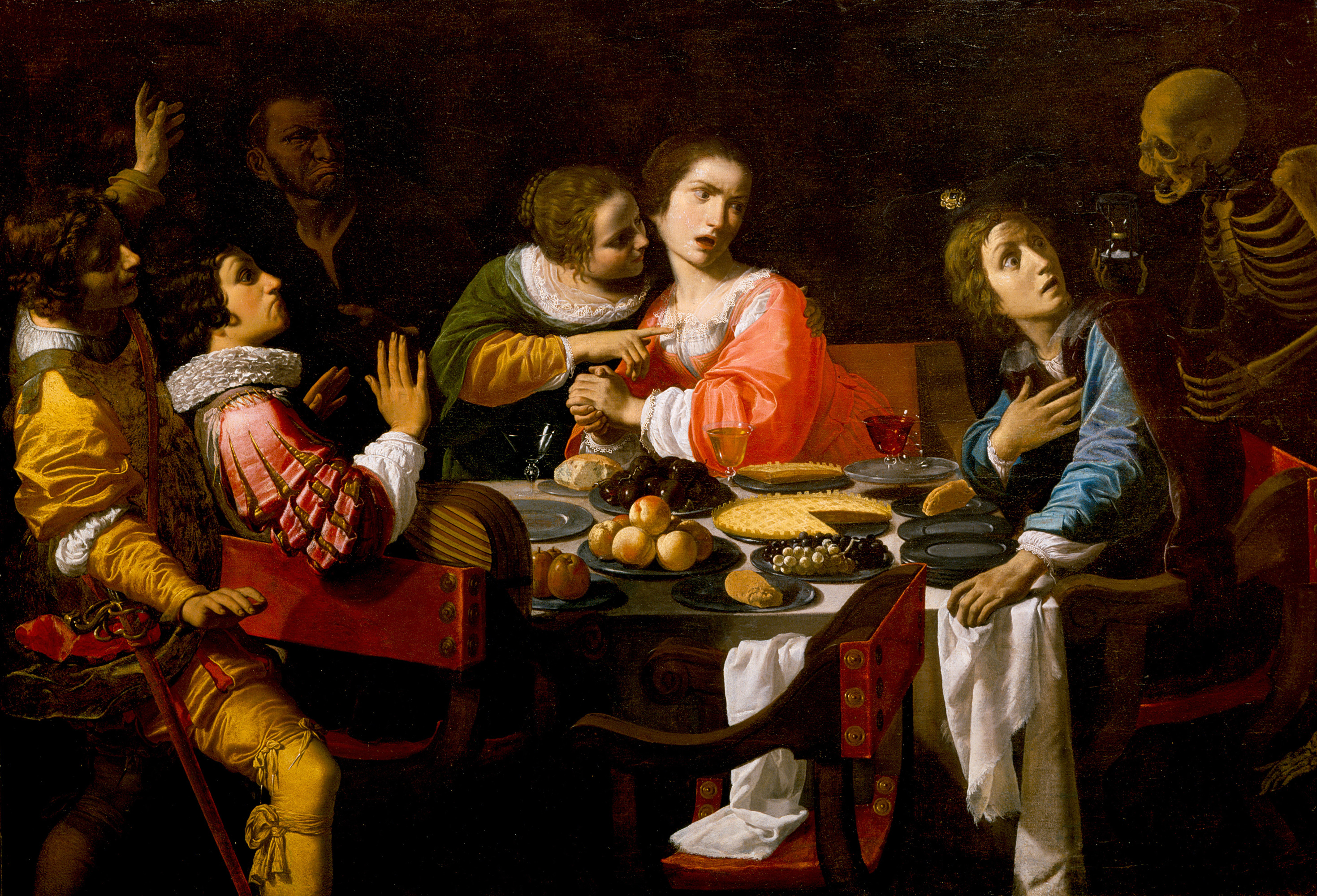
Giovanni Martinelli says welcome to Death!
There will be a pain, or you will feel strange or dizzy and find yourself looking up at the ceiling. Or a wound or accident will occur, your awareness causing a sinking feeling as you realize the outcome.

What this means is that what we choose to do with our time is important. The characters you roll up in a simple moment for your D&D game are different from any other character created, because for a short while they exist.


This has nothing to do with the school of play. Gus L's comment about the party being the focus of the adventure is a core pillar of fourth edition. It is of critical importance to have a party, the above is just as meaningful for that type of game as any other.

Death, character death, and the possibility of it is what makes gaming matter. If there is no threat of failure, then the activity carries no risk. With no risk it can still be a fun activity, but it loses value. If we take on the arch-dracolich and know we are going to win, then we hung out and rolled some dice with friends for a few hours to come to a known conclusion.

If we did it and we know we can lose, a real meaningful thing happened.

When the life we led flashes before our eyes what I want to see are the things that I accomplished that might not have been. You can't have that without failure, without character death.

So the next time a player complains about character death, validate their feelings. "Yes, that is very frustrating." Let them roll up a new character. They will learn to play more intelligently. And when they accomplish something, determined not to be killed this time, it will have real meaning. Because their accomplishment might not have happened.

And that will be a session to remember.