Tampilkan postingan dengan label theory. Tampilkan semua postingan

On the Quest for the Hammer of War II

Yesterday we took our first look at the digital version of Warhammer Quest. Today we're going to look even deeper under the hood.

The Changing Game

Me recommend not playing on hardcore mode sounds crazy, right?

I'm going to talk about the money, because it's relevant to the design. When it was released, I paid $4.99 and bought Warhammer Quest. 

The $4.99 includes the first campaign and the 4 basic heroes. At first, this was all I purchased. I began a hard-core game. There were other heroes available at launch, and soon I paid $2.99 each to purchase the ogre and shadow strider. This was helpful because I could level 6 characters and if i lost one, I didn't have to start with a new level 1 character. This 11 dollars purchase was very enjoyable. I spent about 30 hours on the basic campaign and questing, ending with my heroes around level 5. This included more than one party wipe.

At the time the only in application purchases was the option to purchase in-game gold at ridiculous rates. $3 for 4,000 gold, up to $30 for 60,000. 60,000 gold doesn't go as far as you think, I collected over 3 times that in just a standard play-through. 60,000 gold only levels 4 characters to level 8. It is also cash spent that removes gameplay. I generally try to avoid those kinds of purchases.

In case this isn't clear, the game is a fantastic value. I recently took my wife to see a movie, 32$ and two hours later it was over. $11 for 30 hours of entertainment is an excellent value.

I then put the game down for over a year. When I picked it back up again, they had released several new heroes, two new campaigns (skaven and brutal hoard), and new undead units and tilesets. I purchased them all. The campaigns are $4.99 each, the tilesets/monster packs and characters were $2.99 each. I spent around $30 to pick them all up. This provided another 40 hours or so of gameplay to complete each of the new campaigns.

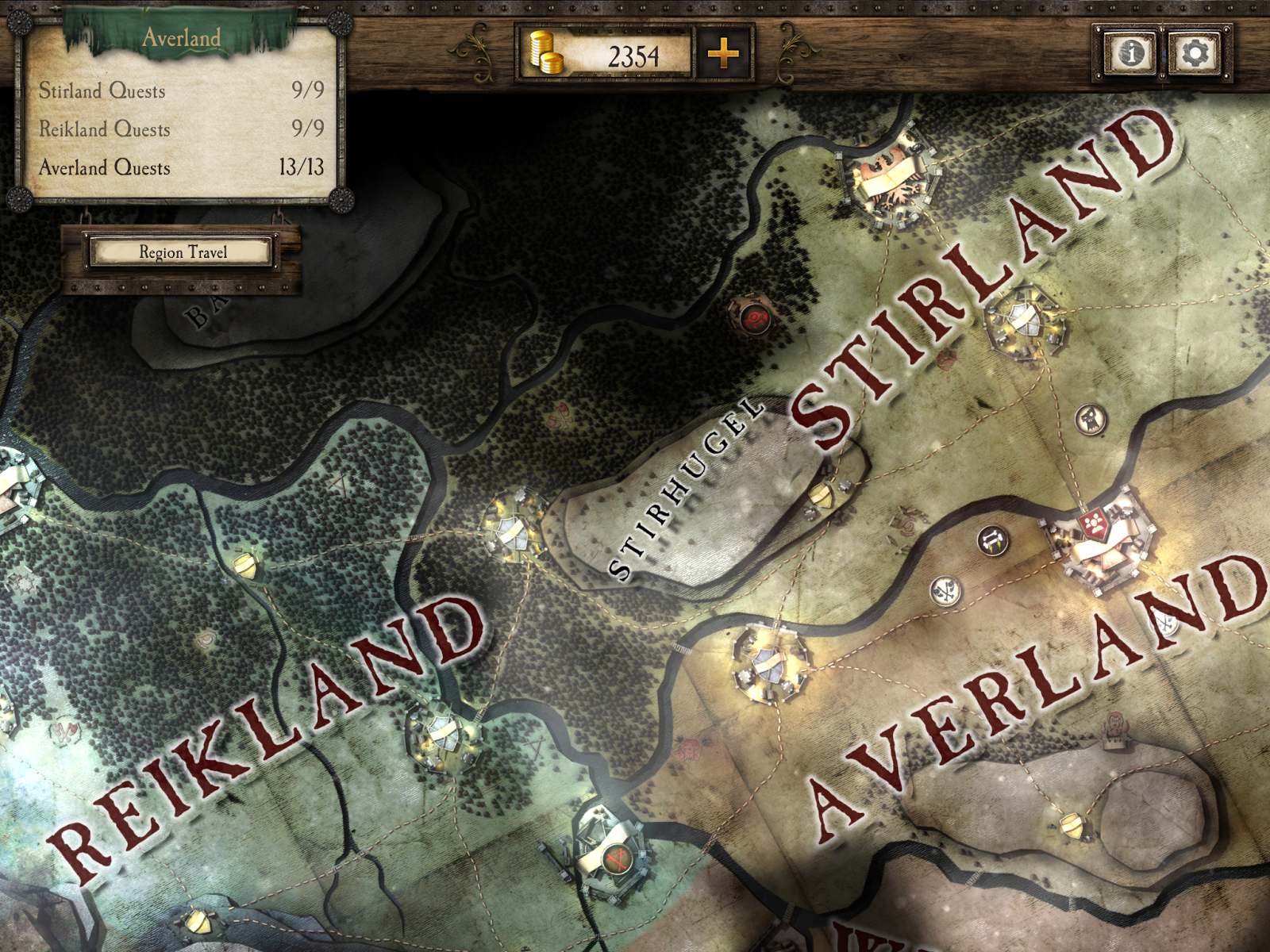
A short word on each of the purchases. The new campaigns are connected to the old one on the overworld map. You can start the new campaign by simply fast traveling or just by organically exploring the map. The Skaven campaign (Riekland) challenges players from 2nd to 6th level, and the Brutal Hoard Campaign (Averland) raises the level cap to 8 and challenges players from 4th to 8th level. 

In the year since I played, they also introduced another IAP—Lore Magic. Each point of Lore Magic allows you to kill all the enemies, or raise all your dead, or double the gold rewarded for finishing a dungeon. You get 3 points for free.

You can of course purchase them for .99 cents each, get 5 for $3.99 or 20 for $9.99.

The Rub

When I played the base game, I somewhat infrequently lost players and had to re-level them. More than once I had a complete party wipe, but there were always new characters to pick up the gauntlet, and it was fairly easy to get new characters up to speed.

However, when moving into the expanded content several things changed. First, the investment of the characters went up. Way up. Characters now might have upwards of 6 or 7 rare items, the result of multiple quests and thousands of gold. In addition a level 6 or 7 character is nearly a 20,000 gold investment in itself.

You know what? That's fine. The real shock came from the vampire/zombie and necromancer/skeleton expansion packs.
These expansion packs are what is left of the abandoned Wissenland expansion (Warhammer Quest: Never Lucky), one of the undead and gothic castles. That expansion was abandoned when Rodeo games (a small four person studio) got the contract to produce Warhammer 40K Deathwatch, another tactical squad based game of space marines versus tyranids. It is also quite good. But this caused them to abandon Warhammer Quest and release the content in progress as monster expansion packs.

So here's the thing about Vampires, Vampire Thralls, and Necromancers. Death Shriek and Crystal Maze. Death Shriek requires no LOS and attempts to stun your entire party with a high chance of success. Crystal Maze removes one of your players from the game for a turn, and if the caster is killed, the unit dies also. One of these units given a turn can wipe the part on an unlucky roll. They can appear in groups of 1-4, but usually only appear 1 or 2 at a time.

To be clear, Dungeons take about 10-20 turns to clear. Sometimes more, sometimes less. A die is rolled every turn. There is a 1 in 36 chance of two enemy spawns in a row. Unsurprisingly for a 4th-6th level party, these encounters were frequently fatal.

What's more is that the new tilesets primarily consist of long hallways with obstacles. This means the vampires and necromancers would frequently spawn up to two or three tiles away (20-40 squares, when units have a movement of 5-6) and the obstacles in the hallway would impede progress. This meant you would frequently be in situation where you couldn't melee the magic-resisting vampire because your warriors couldn't reach him because of all the trash mobs between you and the target. And since they can resist magic and ranged doesn't do enough damage, it's difficult if not impossible to kill them on the turn they appear.

Now, if I had a 6th level character die, I couldn't just restart with a new 1st levelcharacter, because the only way the characters gained levels was by being the person to kill an opponent. At that level, they would only do minor damage and would either need a lot of equipment or luck to  manage to hit an opponent of that level, much less slay one. You could of course spend some time trying to get one down to low hit points and give the new character a chance to hit them, but every extra round you are in the dungeon is quite deadly. Another option would be to reset the low level quests and spend a long time just blowing them completely out of the water with level 6's and one level 1 character every time someone died. The random quests are based on average party level, and unsuitable for leveling.

Now, having a party of 8th level characters has shown me that these encounters are quite manageable. What this indicates is that the new expansion must have been geared for a higher level cap and level range, because for a 7th or 8th level party they represent real danger, but not a panicked near wipe every time they appear. I do not fear them as I once did.

Blood for the Blood God!
A lot of this has to do with the changing nature of play, and is similar to what occurs around mid-level in most games of Dungeons and Dragons. Put quite simply, by the time you are likely to be killed in an encounter (rocket tag, 3.5 expected losses, etc.) you have access to magic that allows you to raise your companions from the dead. Why is this? The amount of investment in the character sort of demands it. Not simply because you don't want to have your character die, but because the character often becomes central to the events. Not only is a new character unsuited for the challenges, they will have little connection to the events of the campaign.

Look at the solutions various versions of Dungeons & Dragons have demanded. For adventure paths, 3.x/Pathfinder suggest creating a new character one level below the average party level. The path contains the story, so the character is replaced by one of approximately equal power to able to handle the challenges of the adventure. In a more old school sandboxy type campaign, you'll find henchmen, hirelings, and "secondary" player characters all over the place. This way, if someone dies, a new character who's already involved in events can step forward. And of course, there's always the raise dead option for when a corpse is available or resurrection or reincarnation for when you managed to get yourself disintegrated or fallen in lava.

Of course, the same is true of Warhammer Quest, for the low, low, price of 1$.

And to be clear, there are resurrection options available to the wizards in the game, while on the mission. Of course the problem is that Death Shriek stuns most of the party, and they all end up dead. Your wizard can't raise anybody if he's a corpse. 

Rodeo Games makes some of the best turn based tactical strategy games. Full period. They are a small company, writing games for a niche I happen to love, and they got there by doing hard work with the promise of nothing. They do right by their Games Workshop licenses  and have excellent customer service. So I have no problem with giving them money. And indeed, to avoid several unexpected, uncontrollable wipes, some magic points were used. 

Of course, now I won't be playing the game in Hardcore mode anymore.

This particular element of design didn't detract from my experience of the game. I think the variety provided by the monster expansion packs helps a great deal. And you've got more than one option. If you don't purchase them, you can play hardcore mode. You'll face the above challenges, but you'll be less likely to view them as "Unfair" and more likely to trace your failure to a poor decision you made. Or you can play regular mode and pick up the expansion. Or you could do what I did, and experience your failure not as a loss of your time, but one of a dollar in your pocket. I earn way more in one hour then I spent on magic points and losing those characters was an investment of dozens of hours.

It's game design that hits you where you feel. It certainly qualified as an interesting choice—one that was painful to make. That is the mark of good design, I think.

And who knows? It's early yet. We might see an expansion for Wissenland yet, along with a few more characters. I got a hope.

Sublimity

That's not all of course.

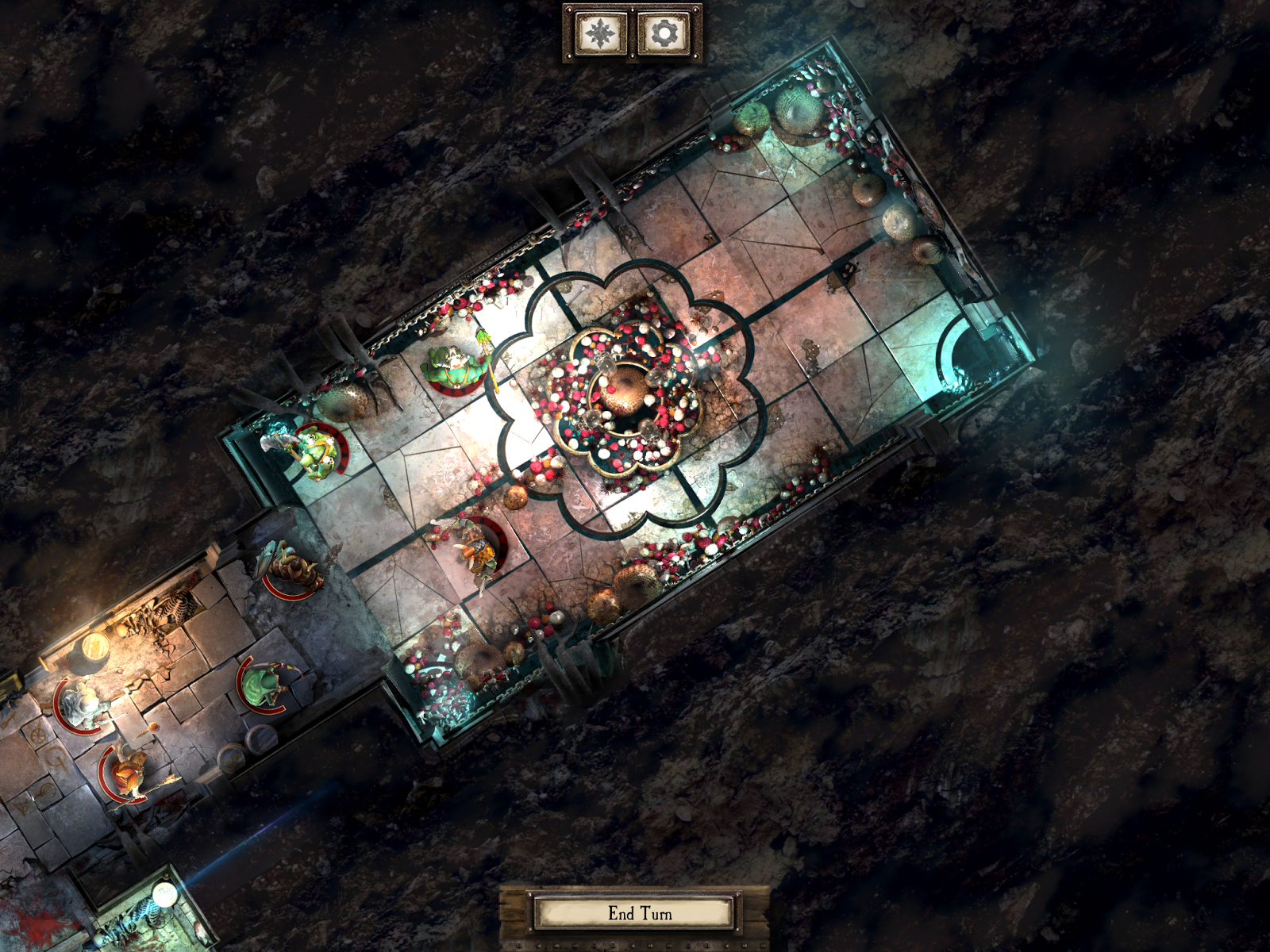
Warhammer Quest is a beautiful game. When you visit a city, a book opens and the city builds itself from the page. Weapons and armor equipped are visible on your characters. Blood splatters as you wound enemies. Lights spin on the ground. The dungeon is incredibly detailed.

And because it's on an iPad, the physicality of it adds to the experience. You tap on an enemy to attack them—you literally hit them to hit them.

You can't underestimate these factors. One of the reason Hearthstone is such a wildly popular game, is the visual design of it. When you start the app, you open a magical wooden box where you store your cards. When you open a pack, it shakes and bursts apart. A legendary card results in a brilliant golden halo burst across your screen. It is intensely satisfying. 

Warhammer quest has that attention to detail. Smoke drifts by on the opening screen. Light sources sparkle and gleam, spells glow as they streak across the battlefield. Skeletons blow apart when struck by a club. The importance of the visual appeal and the user interface can't be understated. 

That isn't to say, eventually like all games, the visuals fade into the background once you get into the flow, and for all it matters it could be colored blobs moving through the plain grey dungeon (goodness knows I played enough Wizardry). The gameplay is solid and engaging, and that's the draw. The fact that is a pleasure to watch and use only increases it's appeal.

There's also a fair bit of replayability available. Not only is there a selection of characters to choose from, their development is somewhat random, as it is in the board game. When they level up, they usually gain a skill. There are more skills available then they can acquire. This means to unlock all the journal entries, you'll have to level up characters more than once to see all their available skills.  My max level Marauder has 7 out of 10 available skills. So each group of characters, even if they are exactly the same classes will play differently. How many wounds (hit points) and power and power store each character have also varies with level.


In addition, there are several hundred items in the game. Even now, I'm finding new items at quest locations. Most of the gameplay is very similar (and very fun and rewarding), but the quests actually shake things up quite a bit. Several ask you questions about what happened earlier, others add and change things in the battlefield, many give you choices to make during the quest, and there's even one or two puzzles. 

It is, quite simply, a wonderful experience for a dungeon bash aficionado. 

The Competition

So, why can't we having nice things? 

This isn't the only fish in the sea, and it's well established why Warhammer Quest went out of print and isn't sold any longer. There are other, more modern tabletop games that emulate the Dungeon Bash style. I've given more than one a try and they are all lacking.

Descent and Descent 2 is the most popular, including a campaign, characters, artifacts and more. But it requires one person to be the overlord and to play against the players. In addition, the experience of levelling and improving your character is very flat. Once it occurs, all the other opponents increase in power by an identical amount. 

A recent kickstarted entrant is Super Dungeon Explore, a chibi style arcade type dungeon crawl bash with features such as monster generators. But in talking with people who have played it, the winner is decided pretty quickly, leaving you to play out the last two or three hours before the game actually ends. In addition, it also requires one player to be the "console" and control the other monsters.

The suite of Dungeons & Dragons board games Ravenloft and Ashadon get the basic aesthetic correct and don't require a Dungeon Master, but are balanced inconsistently, have only the option for one chance based improvement, and limited campaign play. 

Somewhat unsurprisingly, there just aren't that many options available. These games are difficult and expensive to make with hundreds or sometimes even thousands of pieces, including miniatures. And usually by that point, people just throw in the towel and start playing Dungeons and Dragons if they thirst for more. 

That said, we are lucky Warhammer Quest got made and is available. It's a classic of the genera, beloved by fans, and done lovingly by Rodeo Games. 

If you get the chance, you should go kill some orcs. 

Hack & Slash 

On the Quest for Hammer of War


There are certain games that come along on certain platforms at certain times that define a purity of gaming experience. They are perfect traps for the mind. They are so powerful that even after you stop playing, when you close your eyes you see the game, playing out on the back of your eyelids:Tetris on Gameboy, Goldeneye on Nintendo 64, Street Fighter II Arcade cabinets, Bejeweled on smartphones. I'm sure you can think of one or two more.

Warhammer Quest for iOS on ipad is one of those games.

It's helpful that Warhammer Quest itself is considered one of the best, if not the best dungeon bash game of all time. Now out of print, after an astoundingly short print run of 3 years (1995-1988) if you wanted to get the tabletop version, you'd need deep pockets and a passion for ebay. But even so, that version is inferior to the digital version brought to us by Rodeo Games.

Why is the best dungeon bash board game of all time out of print? Money. Games Workshop is interested in selling goods that have a long tail, and although the tail was quite long on Warhammer Quest, with extra classes, treasure and dungeon expansions, and more, it wasn't long enough. Games Workshop is interested in publishing miniatures and miniature accessories. Books and cardboard are costly for them, and have a lower rate of return. The game, although popular, was never very financially successful. Only one person needed to buy the game. Only one expansion was needed for each group. There may come a day for a reprint, but it won't be soon.

iOS

We are talking today about he iOS version. Luckily, it's also available on Steam, so if you're reading this, you do have an opportunity to explore the game. But the iOS version is superior. 

As fun as dungeon bash games can be, they are a little fiddly. Warhammer Quest contains over 200 pieces, almost 100 different cards, and somewhere north of 200 pages of rulebook (although only 20 or so contains the game rules, the "role-play" book is the majority of that page count). Manipulating the actual game is quite time consuming. iOS removes that difficulty.


But that's just addressing what digitizing a game does. You get many of those features on Steam. Steam brings the game to a much wider audience (instead of just those subset of people with ipads). However, the portability of the ipad, along with the display is the perfect size to both show detail and play the game at. Open the game on the computer and it's in a small window. Blow it up full-screen and it becomes fuzzy. You're either too close or too far out. The display, size, and portability of the ipad version is sublime. As well as the fact that you rotate the ipad vertically to access the inventory. Which is just one of those mind-blowing innovations that we take for granted living in the future.

How do you check your inventory? You open the bag and look inside.

But what about the game itself? Why is it so good?

A design analysis of Warhammer Quest

Warhammer Quest is a dungeon bash game. You take a party of heroes and they descend into a dungeon, usually made of tiles and fight monsters and recover treasure. As they recover treasure, they become more powerful and level up. You may be somewhat familiar with the concept.

Dungeon bash is a specific board game niche. It's a relatively large niche title; Rodeo games has sold over 250,000 copies of the digital version (at least—sales may be above 500,000), along with however many actual print sales their were, so as niche as something can be that has a quarter of a million sales. But it isn't on the scale of a mainstream title, like Dominion, Dungeons and Dragons, or Settlers of Catan with tens of millions of sales.

A dungeon bash game is different than an adventure game in that it focuses on tile-based movement, line of sight, and tactical combat; this includes games such as the Dungeons & Dragons adventure games and Descent (and Descent 2). This is in opposition to adventure games like Arkham Horror or Talisman which are adventure games, due to a lack of tactical manuvering.

Both the digital and real world version of Warhammer Quest offered expansions in the form of new quests, new monsters, new treasures and new heroes. Warhammer Quest also contained a "role-play" book containing rules for moving among an overland, buying goods from merchants and more.

The digital version is a direct implementation of the complete game. Your party travels from town to town, completing random quests to earn money and gear along with storyline quests. In the quests, they move through each tile to the arrows, when then places a new tile in the dungeon, fighting monsters as they go. Each town has a specific market, and many of the optional characters are available. The rules inside the game, though opaque, are an honest translation of the spirit of the board game rules*.

*There are some minor changes, for example, ballistic skill counts up to six. In the tabletop game, it counted down, and any roll equal or higher to your ballistic skill would hit an opponent. The odds are still identical, though the numbers are reversed. Hence, "honest".

So, that's all pretty straight-forward. What is it that makes Warhammer Quest great?

The rule of 6

The basic system in Warhammer Quest is that you roll a d6. E.g. to attack someone you compare your character's weapon skill versus your opponent's weapon skill on a matrix, and if your number is equal to or higher to the target you hit. A 1 is always a failure an a 6 is always a success.

This is the cool part: Each turn a "Winds of Magic" roll is made. In addition to determining the amount of power your wizard has, any time a 1 is rolled (indicating the casters have no magic power available) an event card is drawn. 70%+ of the time, this is an encounter with monsters. This roll is made every turn, even while in combat! Not only do 2-12 new enemies appear, however any spell-casters you have are granted no resources to do anything about them.

For a board game involving risk and reward, this is a fantastic system. There are monsters, like orcs, that just attack. There are also monsters like Vampires, Shamans, or Spiders that can cast spells or have attacks that immobilize members of your party. There is enough randomness in this system to allow the no guarantees of outcomes. A slight run of bad luck can spell doom for even the most prepared party.

What this means, is that even in safe situations, small choices matter. Every turn spent in combat increases the chances of having enemies dumped on you, some of whom mustbe killed immediately. With your warriors pinned to the monsters they are fighting and your wizards who always have 0 power when new monsters appear, it constantly creates tense situations.

Every choice matters. Will you push ahead to uncover that next tile now, or take a turn and heal. Where are you positioning your party members? If someone drops, is there anyone with healing items next to them to revive them?

The plus side of course, is that even in a terrible situation, there's always a 1 in 6 chance of survival. Even if the attack is super-powerful or you're surrounded by spiders who are webbing you, there's that 1 in 6 chance your Marauder breaks free and kills enough of them to prevent them from locking down the party. So it isn't over until it's actually over.

Although it is over frequently enough. 

Resource Depletion

Of course the characters have resources to deal with these surprise situations of course. All resources deplete during the exploration of the dungeon and do not replenish until the dungeon is exited.

Wizards may have to deal with the flow of the winds of magic, but each has a personal pool of power that they can draw from to cast spells. Most often this is used to target those dangerous enemies during a turn an encounter is drawn. As they increase in levels, this pool also increases.

The other limited resource is inventory. Potions, bandages, scrolls, and rations can all help the players heal. High-level characters may gain regenerate rings or use powerful magic to heal themselves, but these are of no use if the character is dying.

When a character is dropped, they spend one turn dying. Unless healed, at the start of the following turn, the character is dead. On casual and regular modes, this simply means he/she receives no experience for exploring the dungeon and is removed from play. In hardcore mode, this means the character and his equipment are gone forever.

This means that another character has to be able to reach them (adjacent) and have a healing item available. Then they must use that item and the use of the item must be successful. Usually they are.

But for that 1 in 6. . .

Spell are always successful at healing, assuming it wasn't your spell-caster that was dropped, assuming it wasn't an ambush round and they had enough reserve to cast it, and assuming they don't need to do something more critical with their power.  Skills that heal do not have the same guarantee of success, and in fact sometimes even do damage.

Inventory

So, of course, you just load up on cool items, right?

If only it were so simple.

Warhammer Quest has an unique inventory system. Instead of a paper doll system, each character has four common slots, four uncommon slots, and four rare slots as well as 24 slots split among all characters in the stash (which can only be accessed out of combat). In addition to items you might use, the stash must have room to contain "junk" artifacts for sale found during an adventure, as well as any replacements for healing or replacement items you wish to carry.

Of course you are constrained. You can't wear two helmets. If you have an uncommon helmet, and you put on a legendary helmet, the uncommon one is transferred to your inventory.

The whole system is filled with significant choice. You may notice that I'm not wielding a rare bow, instead opting for an uncommon one with my Marauder. It provides a strength bonus, increases his melee damage, which since he has 9 melee attacks (and only 1 ranged) is a good choice. The bow isn't available in a town or from an item quest, only as a random reward from a "rescue" quest for a fletcher or blacksmith. I also had to ditch my rare shield, needing the bonuses to armor, attacks, and chance to hit instead.

Those healing and replenishment items you want? They are expensive. It costs progressively more and more to level your characters (200->500->1,000->2,000->5,000->10,000->15,000). A common healing item costs 10. An uncommon one costs 100+. A common power store item for wizards costs 300, a rare one costs 1,000. Money is tight, often it's a choice between leveling a character or buying new equipment.

You are never outfitted as well as you wish you would be.

The Dungeon Tension

The fun of Dungeon Bash games, and in fact Old School Dungeons and Dragons (Original and Basic/Expert) comes from the tension in survival. The dungeon is dangerous, at any given moment it could violently kill you, but if you're lucky and skillful you can get away, having put one over on it.

This survival tension (and the importance of the hard-core nature of these games) means that the choices made during play matter and create for a pulse-pounding situation. After spending 6 hours and thousands of gold to outfit and level your grey wizard to 5, having him fall to the ground and be uncertain any of your teammates can reach him can put your heart in your throat.

You don't want to lose that time. Your time is important, you only have a limited amount of it before you die. It's kind of a rush.

The reason Warhammer Quest is such a good game is that it really skillfully consistently creates this tension. The original game did also, but the digital game sustains that feeling, speeding up the actual play of the game to focus on the fun parts, and is overall an excellent experience.

But for the full game, I don't recommend the hardcore play mode. . .

Find out why tomorrow in part 2 of our Warhammer Quest Analysis

Hack & Slash 


On the "Missing" Delay Action in 5th Edition

It's not missing. There is no Delay action in 5e.

Why?

Because it makes a better game.

One of the nice things about the Modern Role-Playing Game world is that we have learned some things. Objective things that allow us to handle arguments in new ways. One of those, is that the goal of the design of the game is player enjoyment and weighing that against costs.

This means that arguments from realism can be dismissed!

No longer must we wade through pages and pages of endless debate about real world experience and what makes sense! We can simply decide what we want based on what we think is most fun.

When people talk about defending the delay action, they talk about verisimilitude and attempting to do things under strict RAW. This may be important for some people. You can see the effects of designing a game from this standpoint by playing a mid-level Pathfinder game.

The Delay action slows play down. Do you want to slow play down?

Does it sit better with people to be allowed to skip their turn and interrupt the game to take it when they want, because it makes more sense?

Let me tell you a story. Once, in a game I was in, we had a new player. There wasn't a good place that made sense for a new character to appear, so that player sat in the room, unable to play for five hours. The game ended without him getting to join the group. He never returned to another game ran by that Dungeon Master.

Verisimilitude, especially in a game where flying gnome wizards cast fireballs, can die in a fire.

The second part to this delay argument is where you might have a Dungeon Master who wants to run initiative rules as written for things like, entering a dungeon room, or maneuvering in a narrow space. This has nothing to do with the rules, which are explicitly set up for the Dungeon Master to make judgement calls to speed play along to the interesting choices and enjoyable play. If you've got a Dungeon Master who's doing that, more rules are not going to make him be less of a dick. He'll just be a jerk in more technical and new ways.

This isn't just some sentiment I'm writing up in response to (not the first) place this discussion has been had. It's a call to action for people to say, "Yeah, that isn't in this game because it slows down play." instead of getting involved in a debate over why you can't avoid taking your turn and whether it makes sense.

Of course, the design team is on record as saying, you know, you can put it back in if you want. And really, you can. The question just is, if you're houseruling ways that can complicate and slow your game down, you have to ask yourself why? What does it add? And if the answer is "It makes me feel better about the rules" or "It stops my Dungeon Master for making things difficult for us rules as written." then maybe you should examine your motivations and find out if there's better ways to address that. If the answer is "It makes the game more tactical," then perhaps playing a more tactical game is the answer to that.

Hack & Slash 

On the Defining Characteristic of 5th Edition.

It takes a while to figure out what each edition is about.

For example, in Basic/Expert, monster hit dice are d8, without a corresponding increase in player hit dice, causing player death to be exceptionally common. Experience is mainly given for treasure, not slaying monsters. This contributes to characters of higher scores being more survivable, retreating from combat and finding ways around the monsters become what the game is "about".

In 3rd edition, the game was about character builds, trap build options, non-multiclassed caster mastery, 5-foot steps, and killing monsters.

4th edition was about dynamic battlefields, unique opponents, timing and triggering your healing surges, striker dominance yet controller necessity, and tactical challenges.

Well, I think I've finally played enough 5th edition to really find out what the game is about.

The Defining Characteristic of 5th Edition

5th edition is a good edition of Dungeons & Dragons. I've run it for characters up to level 8, and played in several games as a character.

Why is it a good edition?

  • Like all the best editions of Dungeons and Dragons, it doesn't tie you down into a mathematical model. It encourages you to be creative and focused on (and forgive me here, I'll shower afterwards. . .) the fiction. 
  • There are no (or ridiculously few) trap options. Multi-classing works. Spellcasting works. Fighting works. There's a few odd peaks and valleys in the power spike, but there is a far greater equity between classes not seen in a long time. Play what you like!
  • Combats are, in general threatening. Characters are resilient enough to survive while still feeling threatened. 
  • Spells, and their many limitations, allow spellcasters to do great things—but in a very limited way, without overshadowing the other classes.
Which brings us to what 5th edition Dungeons & Dragons is really all about.

The Reaction

Like most versions of Dungeons & Dragons, it isn't until mid to high level play until this becomes apparent. 

The first, and most notable change is in the available combat actions. 

There is no delay action.

You take your turn on your turn. Not only does this speed up play, it specifically limits when characters can do something. The only time you can do something outside of your turn, as a player, is by using your reaction. You have to use your reaction to "delay". Your reaction is also tied into certain abilities that define play.

You can only ever, ever, have one reaction.

This turns mid (and expectedly high) level play into a bluffing game of rock/paper/scissors. All of the following are reactions, and are noted because of their powerful utility. Reactions that do a few points of damage or other minor effects aren't listed. 

Let's look at some reaction abilities in 5th edition, and why they are so game defining:

Class Abilities:
  • Cutting Words (Bard): Reduce an Attack Roll, Ability Check, or Damage Roll, by a bardic die value (d6-d12)
  • Warding Flare (Cleric: Light): Impose disadvantage on an attack roll, Wisdom Modifier times per long rest.
  • Dampen Elements (Cleric: Nature): Grant resistance (1/2 damage) to elements.
  • War God's Blessing (Cleric: War): Grant +10 to an attack.
  • Riposte (Battle Master): Use your reaction to attack, adding a superiority die to damage. Powerful because it doubles the attacks at low levels, and adds and additional 1 to the two per round at mid levels. Drops off in utility as you increase in power.
  • Deflect Missiles (Monk): Not powerful, but very very fun for monk players. They all giggle when using this. I've never seen anyone not spend the ki point to throw the missile back.
  • Uncanny Dodge (Rogue, others): Halve the damage of an attack. (not melee, not missile, not spell, attack)
  • Misty Escape (Warlock:Fey): !! Use your reaction to turn invisible and teleport 60 feet!
  • Projected Ward would go here, but doesn't, because abjurers have much much more important things to do with their reactions.
  • Instinctive Charm (Wizard:Enchantment): Wisdom save (low on brutes) nullifies an attack against you and directs that attack against an enemy.
Feats
  • Defensive Duelist: Add Proficiency bonus to AC.
  • Mage Slayer: Attack Spellcasters casting spells, forcing a saving throw.
  • Sentinel: Attack someone who makes an attack not targeting you, (also can attack when a creature uses the disengage action and negates movement on disengage if the attack hits!)
  • War Caster: Cast a spell instead of a melee attack as an opportunity attack.
Spells
  • Counterspell: COUNTERSPELL. Use a reaction to nullify 3rd level and lower spells. 4th level, you must roll your spellcasting ability, versus 10+spell level. Because it's an ability check, bards even add 1/2 their proficiency bonus to this roll, making them the best counterspellers in the game (outside of Abjuration specialists after level 10.) You can use higher level spell slots to nullify higher level spells. Casters teleporting or flying away? Anyone casting a spell within 60 feet? Nope, nope, nope!
  • Shield: +5 AC till your next turn. Eldritch knight, Plate (+8), Shield (+2), Defense (+1) Means, as long as he has a spell slot, his AC is 26 without magical bonuses. At 3rd level, if they can steal a suit of plate. 
What this means, is, that high level encounters involving tanks and wizards, involve trying to eliminate reactions, bait reactions out, or get within range of creatures to use your reactions. Any encounter where one side is using their reactions to nullify the actions of the other, and the other side isn't has a huge advantage.

What I mean, is that a party that ignores this, and goes against a wizard (who isn't an idiot and took counterspell) and any kind of fighter designed to protect his companions (High AC+Sentinel+Shield) and instead just goes in, a blasting/hitting is going to lose. Reactions will cancel their spells, disarm their opponents, and deflect their attacks. Place the party against two spellcasters with counterspell and watch only one side have spell superiority.

Take a look at this erroneous discussion (correctly answered by Chris Perkins) about if you can counterspell a counterspell. You absolutely can, of course. But to use your own reaction to cast a counterspell, you'd have to stop casting your original spell and lose it. 

Of course, this is addressed directly in the design, with high monster hit points and damage, along with legendary actions, allowing things like dragons to actually have a chance to escape against sentinel/counterspell lockdown tactics. 

Welcome to 5th edition play.


Hack & Slash 
Follow, Google +, Newsletter, Support, Donate to end Cancer (5 Star Rating) (123$ donated so far!)

On a Limited Campaign

You're reading this blog why? Because I talk about D&D and you like that probably. Also, I'm into doing stuff that makes your campaigns better. Yeah.

You want a better campaign?

Keep it limited.

It's already in the air. One or two 5th edition books a year. Pathfinder creaking like the bounty after their overly excited engineers got ahold of it and thought adding just one more feat sixty times would make it better. The fact that she was sunk two years ago is just a WEIRD COINKYDINK.

One of my players said, "Can I use the Princes of the Apocalypse spells in your Tyranny of Dragons campaign?" I was like "NOPE". Whaaaaat? Impacting agency? Am I being a jerk?

You want a good campaign, keep it limited.

7 races. 7 monsters. 7 significant NPC's. 7 forces. Seven schools of wizards with seven spells per level. Seven fighting styles. Seven ancient lores. Seven great weapons.

Example:


  • Races
    • Humans*
    • Lizard-men
    • Yuan-ti
    • Boarmen
    • Feral Halflings
    • Elves*
    • Gnolls
  • Monsters
    • Zombies
    • Implacable Giant Bear Monsters That shoot fire beams from their eyes. (Secret surprise, they turn into sharks.)
    • Giant Toads
    • Hydras
    • Tribal Carnivorous Apes
    • Acid Weasels
    • Bullywugs
Can you see that campaign in your head? Is it memorable? The starred races are the ones the players can start as. The others would have to be unlocked. This isn't generic. It sparks the imagination.

Part of the issue is that this either happens subconsciously, in that we tend to focus on the consequences of the encounters we have, in the future. What this ends up looking like in play, is that there's the main thing (we keep running into X) and then a bunch of random one-offs that never have time to shine. Having all those random one-offs being in theme makes things more interesting in play and brings a great deal more cohesion in the campaign. 

Another example, My Tyranny of Dragons campaigns has: Humans/Moon Elves/Shield Dwarves/Lizard Men/Orcs/ and halflings for races. It has Dragons/Drakes/Cultists/Giants/Bullywugs/ Kobolds and Hobgoblins for monsters. Cultists and dragons are divided into 5 types. 

If you have a wandering monster table with more than 7 things on it, the chances of encountering anything more than once is vanishingly rare, meaning the area is less thematic. I'm not the only one talking about this. But I'm the one that's saying, let's look at the numbers. 

If you have a six hour session, and you roll for 1 in 6 random encounters. You check that die somewhere in the neighborhood of 20 times. That means about 3 random encounters. On average, with 20 entry encounter table, you'll have 6 encounters before there's a 50% chance of duplicating one. That's a 50% chance of getting a duplicate encounter every 2 weeks of play. Not very thematic or consistent. If your table only has 3-5 entries, that threshold drops to 3 encounters.

There's more to this too! If you're using a spoor system or an overloaded encounter die, then the results become more significant, because the players will really become familiar with these monsters. These monsters and their interactions can be fleshed out, creating a more complex ecosystem that your players are adventuring in. Add in 4 lost dead races (for different kinds of ruins) and some different factions (tribes/cults/etc.) that your races are a part of, then you have a strongly themed adventure. 

Obvious benefits are that when you do include something from out of theme, it will really make an impact on your players. Most of the campaign builds itself from the juxtapositions in the limited list. You end up with a world that doesn't feel like generic fantasy. These seven choices aren't forever. Most campaigns last from 3 to 6 months. Instead of changing campaigns, as yours evolves, you can change this list!

Hack & Slash 
Follow, Google +, Newsletter, Support, Donate to end Cancer (5 Star Rating) (123$ donated so far!)

On the Special Snowflake Setting

Today we talk about the most important fact in gaming.

There's been a lot of talk about Special Snowflake Settings and experience with a variety of Dungeon Masters. Hell, tens of thousands of people have used my Guide for New Dungeon Masters to start running games, including my wife.

She killed the entire party in her first game. It was awesome.

The problem is, all of these are polite guides and statements that allow people to continue to ignore the most important thing about gaming in the entire world forever.

The Special Snowflake Setting

So what's the problem with the special snowflake setting? Why does it even have a bad rap at all, much less one that's so bad that it's considered gauche to use it?

This is a problem with definitions. Chris Kutalik in his second post on Special Snowflake Settings  describes an evocative mythical forest environment, and how enjoyable it was to play in such a unique and creative setting.  This is in counterpoint to the extensive world-building and how nobody cares about what color hats people wear and how he's glad no one is complaining about that anymore, because good riddance.

This is, I believe, a conflation of two different things.

He notes that in Harald Wagner's game the setting was described with a series of bullet points. Other than those changes it was by the book Labyrinth Lord. The Special Snowflake Settings are not like that.

Instead Special Snowflake Settings required large amounts of knowledge, a significant buy-in before play, and had many firm and unchanging elements that were considered both integral to the setting and immutable. Why? Money and politics.

I'll give you an example of a broken special snowflake setting and how I fixed it.

The Specialist Snowflake Setting of All


The best example is, of course, the Forgotten Realms. In the beginning, it was not a Special Snowflake Setting. Some of the early role-playing game books by Greenwood and Jaquays are the best supplements in gaming. But it has turned into one of the worst offenders of the Special Snowflake Settings that exist, due to the weight of the accumulation of years and popular characters.

Drizzt and Elminster are the worst offenders. Others, like the human, Mirt the Moneylender, who's still alive even after the timeline was shifted forward a hundred years are also included. Why did that happen? Well, Mirt is one of the key figures of the setting (as one of the masked lords of Waterdeep, ooops, spoilers) and Wizards of the Coast, who owned the Forgotten Realms decided:
"Hey! This will sell better if we steal popular ideas from Ebberon. We can have dragonmarked people, except call them 'spell-plagued', and put in a bunch of cool stuff with our new cosmology like flying islands and add in stuff like Dragonborn, because people like dragons. Oh, we will also need to destroy all the necessary history Dungeon Masters feel they need to run the setting so that they don't have to worry about it, so we'll advance the timeline 100 years."

Of course, immediately this causes a problem for the fiction department who says
"Wait! The books that have Elminister and Drizzit in them sell the best. So we've got to find away around the attempt to wipe history away to keep these beloved characters around otherwise how will we keep the fiction line profitable?"

Also, they made Ed Greenwood cry. Which was a totally shi**y thing to do.

The point is, that these conflicting forces leave the actual Dungeon Master at the table struggling to run his sometimes years-long game, without being subject to the cognitive dissonance of needing to deal whatever changes are being wrought to the system based on the most recently published book. The setting ends up even more convoluted in order to reconcile all the conflicting needs of the forces of profit and politics.

Of course it isn't that the Dungeon Master has to adapt to the changes. But his players might expect him to, otherwise, what's the appeal of the Realms? And that's the damming thing—the thing that brings us to our original point, the downside of the Special Snowflake Settings is their immutability. You can't kill Drizzit, Eleminster bumping into your party seems like a cheap shot, you are no longer a player in a game, you're just waiting until you can play again once the Non-Player Characters leave.

How did I solve it in my Forgotten Realms Campaign? Simple.

Everything published in any Forgotten Realms book or story is simply a fiction of Ed of the Green Wood who lives in the dales, or R.A. Salvatore who lives near the Spine of the World. Their penny dreadfuls and stories are the popular myths of the day. There are no Harpers, No Elminster, no Drizzit. Those are just storybook characters that we tell children to make them feel safe at night.

The Special Snowflake Conflict


The point is, that Special Snowflake Settings are in direct conflict with the most important thing in gaming.


  • They require a large amount of buy in at the start
  • They contain numerous items that remove agency from the players
  • They constrict play by having certain, immutable things
  • It's impossible for any one person, off the cuff, to do something without conflicting against something that someone wrote somewhere.


All Special Snowflake Settings: Shadowrun, Star Wars, the Forgotten Realms, et. al. have these problems.

Let's talk about how that relates to play at the table.

A 16% Enjoyment Rate


That's a pretty terrible percentage of fun for our hobby. But it's exactly the experience that's related here.

She relates a sequence of convention games with Dungeon Masters who took scenarios and made them unfun. She talks about saying no. She talks about listening to the players. I talk about Player agency and the Quantum Ogre. Chris talks about Special Snowflake Settings.

We are all taking about the most important thing in gaming.

Gaming is a social activity where we engage in shared, structured play, for enjoyment.

The reason the my Guide for new Dungeon Masters, the Quantum Ogre, The Alexandrian's "Don't Prep Plots. . . (The Principles of RPG Villainy) and blog posts like The Surest Way to Become a Better Game Master get shared, and reshared, and shared again is because they are being shared by players because five out of six Dungeon Masters are still making people miserable at an event for the purpose of enjoyment.


  • If you are already saying you're a good Dungeon Master, you are part of the problem.
  • If you are already justifying your behavior, you are part of the problem.
  • If you are already deciding I'm wrong because your players don't complain, you are part of the problem.
  • If you are feeling defensive about anything being written or discussed here, that is the surest sign that you are part of the problem.


In fact, if you are doing ANYTHING but thinking about how you need to listen to your players and ways in which you can improve your game, you are part of the problem.

The reason people are talking about this is because you, the Dungeon Master, aren't listening. It's why people keep writing about this. It's why people moved away from more freeform games towards games for more rules. It's why so many books on advice for being a Dungeon Master include saying yes.

Anyone who ever in the history of the world who robbed a bank had a very good reason for doing so.

That doesn't make it right.

A Bit of the Solutions


What does this post do to help the situation?

I was struck by this quote in the article:
"I believe that all these GM's whose games were failures from the player's perspective actually wanted the players to have fun, the player characters to shine, and extraordinary magic to happen during the adventures. Unfortunately, they wanted this to happen along a specific path perhaps dreaming of the way they would love to play through the adventure themselves. And none of us gave feedback because frankly, after a GM has been deaf to your input for six or seven hours, it doesn't seem very worthwhile to tell them "Look, you're not listening."

This is an opportunity missed.

We keep writing over and over the same advice. The trouble is, that studies have shown, that the bottom 25% of people frequently believe that they are in the top 5% because they lack the mastery to understand what mistakes they are making,  the middle 50% all believe that they are way above average, and the top 25% believe themselves to be below average, because they have enough insight into their mastery to tell where they went wrong.

The problem is, that the people who need this advice the most aren't going to listen to it. This is obvious by the experiences people have with public play Dungeon Masters. Clearly articles on the internet aren't cutting it. A refutation of every strange, bizarre, bad faith, misinterpretation of the "listen to your players and give them agency" has already been written. Seriously. If you post any sort of refutation in the comments, I won't have to reply with anything but a link.

So, the problem at this point is that people aren't giving the feedback to the actual Dungeon Masters in an assertive way. This is a concrete skill that can be taught. It isn't easy, but if we want Dungeon Masters to improve, taking the step to give them this feedback is important.


  • We don't want to be aggressive and cause them to be defensive because this will cause them to reinforce their bad habits.
  • We don't want to be passive and stop going to their games, because they won't realize that it's their responsibility that people don't want to play with them. 
  • And we don't want to be passive-aggressive and try to subvert their game, because this provides them justification for their behaviors and makes you feel better at the expense of everyone else. 


We want to be assertive. This will involve some confrontation.

The X-Files Season 03 Episode 20 - Jose Chung's... by mutterz
Be part of the solution.

Also note that this assertive method of interaction also works for people engaging in passive-aggressive, sexist, racist or otherwise unacceptable behavior.

Steps to Assertive Interaction


  1. Ask For Time
    • What this step is about is allowing the listener to prepare themselves to hear what you are saying. What you are really asking for is attention. This will give the Dungeon Master the opportunity to focus and really listen to what you are about to say, with their full attention
    • Note that "No" is a perfectly acceptable response to this question. Your best bet in this case is to avoid playing games with people that don't want feedback.
  2. State your thoughts and feelings. 
    • This has three essential components. First, you have to empathize with the listener. Second, you need to state the problem, and lastly you have to state what you want.
    • If you do this, and you do it correctly, it will be one of their foundational Dungeon Mastering experiences and they will carry it with them to every game they ever run in the future.
      • Empathize with the listener. This contextualizes your interaction as an assertive one instead of an aggressive one. In an aggressive confrontation, you're trying to win. An assertive conversation involves attempting to reach a balance, where your needs are met as well as theirs.
      •  State the problem. The important and hard thing to do at this point is let go of your anger and sorrow. Yes, you didn't have fun. But if you use this opportunity to lash out or attack the other person, you are back to an aggressive interaction. 
        • One good way of managing this interaction is to avoid the use of "you language" instead of saying "You said no and railroaded us." say "I felt we had a good idea/were ignored/had no choice in this scenario."
        • It's important to stick to and mention facts, not judgements. 
        • Use assertive body language. Speak clearly and calmly. Face the other person.
    •  State what you want. This is where you make a specific quantifiable request for change of the persons behavior. It needs to be specific and quantifiable so that there's no confusion about whether or not the person is meeting your needs. If it's not, what they consider "Helping" or "Doing better" might not be.
  3. Listen
    • This is important because here the Dungeon Master is going to tell you why she made the choices you did. They will justify their behavior, and in doing so, give you the insight you need to understand why it's more important for them to meet their internal need, rather than focus on the enjoyment of the shared, social activity. It is important you listen closely so that you can understand what their motivation is. 
    • Once you've sussed it out, it's important to acknowledge their reason and validate it. Once you understand their reason, repeat it back to them to make sure you understand what they mean in your own words. In most cases, it's because the Dungeon Master has a specific idea about how their game is going to go. This is something they will likely feel very strongly about. After you've acknowledge it, you can state your original point, which is that "I felt ignored." or "I didn't feel like I got to make any choices" or "I felt like my enjoyment wasn't important to you." 
  4. Conclude
    • After repeating steps 3 & 4 until both sides have been heard and had their feelings acknowledged, and the other person either has or has not agreed to your specific and quantifiable request for a change in their behavior, thank them for their time.
    • To manage your expectations, remember that no one who was wrong in an argument every went "Oh my goodness, you were so right! Thank you so much, I now see the error of my ways!" Frequently when confronted with their shortcomings, they become defensive and angry. If you follow these steps and allow them to speak their mind, they may defend their actions at the table, but if you're calm, the next time they encounter this situation, they can't help but remember what you said.


Using the example of the session where the players were playing goblins and the Dungeon Master didn't allow the players playing goblins to set fire to a building.

DM: "So, does anybody have any feedback?
PLAYER: "Yeah, I've got some feedback if you want to have it. F--- YOU AND YOUR S----- GAME!" [Flips table]  
Oh, wait, that was the aggressive interaction.

PLAYER:. . . "No the session was great" [Gets up and leaves the table]
Oh, wait, that's the passive interaction. I'm sure I'll get it this time.

DM:"So, does any body have any feedback?"
PLAYER:"I'd like to mention some things, if you're interested in hearing them."
DM:"Sure."
PLAYER:"It's clear you did a lot of work to prepare for this scenario. I'm sure it was pretty hectic for you to come to the convention and run it for us. I'd like to thank you for putting in that time, it means a lot to me." [pause]
DM:"Thanks."
PLAYER:"I'd like to talk about some of the things that happened during the game, is that ok?"
DM:"Sure, uhhh, what?"
PLAYER:"Well, I feel kind of sad. I felt like our plan to burn the house down was a real good one. When we were talking about it, I thought you looked uncomfortable, and I don't understand why we weren't able to burn it down. I think that would have been a real funny thing for the goblins to do. I feel it's important to listen to your players, to get an understanding of what they enjoy in a game. In the future, I'd like it if you listen to the players when they are excited about something and consider how you could adjudicate it instead of saying no."
DM:"Oh, well, If you did that, you would have missed all the treasure in the house and the fight wouldn't have been fair, and all that work would have been wasted!"
PLAYER:"So?"
DM:"Well I put in a lot of preparation!"
PLAYER:"I hear that you spent a lot of time getting this game ready. I could tell, that's one of the reason I thanked you for it."
DM:"I don't want all that to go to waste, and you would have missed all of that treasure."
PLAYER: "Yes, its true. That preparation would not have been used today, and our characters would have missed that treasure. That would have been a good in-game consequence of our choices."DM:"You just wanted to make the game unfair. That idea would have ruined the challenge of the combat."
PLAYER:"I hear that you really value providing a fair challenge, and there were a couple of encounters that were really hard later on. That horse gave us a lot of trouble. But not every encounter has to be a tactical challenge. There were consequences to us doing it that way too, losing the treasure like you mentioned."
DM:"Yeah."
PLAYER:"So, all I'm asking is that next time the players ask for something that seems like they are excited, you say yes and adjudicate it fairly."
DM:"Yeah, well, I don't like my work going to waste."
PLAYER:"I think you'd eventually find a use for that material, either when you run the module again, or put somewhere else in another adventure. I'd like to thank you for taking the time to listen to me. I hope you at least consider what I said. Thanks for devoting the time and energy to run a game for us."

Maybe it won't do any good. But maybe it will change a bad Dungeon Master into a good one.

We'll never make any change if we don't try.

On the Campaign Crash

How do you sustain an inherently unstable system?

A long running campaign is a desirable thing. Yet many (most) campaigns crash and burn before becoming memorable. Few get played very long.

For new players the average length of a campaign f is 8 sessions. This rises up to 12 sessions for people playing role-playing games for under 5 years. (source)

So that's what you can expect from a campaign. Two to three months of play. You roll up a character and get him to level 2 or 3 before the campaign explodes. If you're lucky, you might make it to level 5 before the game fizzles out. Real world spanning memorable play there.

And yet the average campaign length of my games is somewhere around 40 games more than double the average of someone of my gaming experience, usually comprising 2+ years of play.

Why is this?

Your game is going to crash.

What you should do is design the game to take advantage of those crash-only systems. For example, leadership positions can not be permanent, because people die. That system is going to crash. Creating a political structure that formalizes the transfer of power rather than just letting it go till it blows up into a war for power has stabilized an inherently unstable system.

This instead of being a negative thing is very very positive. The reason your games end and burn out is because they have accumulated detritus that accumulates through play that eventually becomes more of a burden then the fun that is had during play. This is why rolling up new characters is so enjoyable—they don't have to deal with the fallout from previous actions and choices. At some point this weight becomes overbearing and it drives the game to a crash.

I'm not just talking about choices in game. This is also the fabled Gamer Attention Deficit Syndrome I'm talking about. You are exposed to new ideas and they build up over time until the weight of all those new ideas conflicts with your current campaign. Then you nuke everything and begin again.

You don't have to.

The serial television show

Recently, gamings actor/philosopher in residence Justin Alexander recently talked about bloat in extended narratives—serial television shows. Serial television shows are very much like a gaming campaign. Characters are introduced, plots are driven forward, change occurs and stays. What eventually happens in many of those television shows is that the show gets bogged down in an ever increasing number of characters, side plots, and other events, until it feels like each single episode only contains about 4 minutes of content due to switching between the various storylines. 

He also notes some examples of how some shows avoided the problem. He says:
"One TV series that seemed to largely avoid this problem while also enjoying the benefits of arc-plotting was Buffy the Vampire Slayer. The technique they used seems relatively straight-forward: They limited the number of arc-plots they introduced in each season and made sure that most or all of them were resolved by the end of the season. As a result, when they launched season 6, for example, they didn’t have any more balls in the air than they did when they were launching season 3."
And what he's talking about there is a scheduled crash.

The gaming life

I'm not talking about a single game.

Internalizing this crash process is important, because when you start a new campaign you never do so in a state where you have never ran a game before. You will always start with the experiences, successes and failures of your previous campaigns behind you.  There is no "new" campaign. Just the next one. And just like moving somewhere for a fresh start won't solve any of your problems with your life, neither will starting a new campaign solve any of the problems with your current game.

What is necessary to resolve this issue is some examination of your previous gaming experience. Why do your games end?

Do you have gamer attention deficit disorder? Have events in the campaign restructure the way things work drastically. Your players reluctant to engage in the tedium of a long quest? Resolve it in an unexpected way and have the campaign head off in a new direction. Want to try out a different style of gaming? Switch it up within the game itself. Getting burnt out on a setting or project? Restructure your time devoted to running the game, take turns, or have something new or different happen. Did the characters lose focus because there's too much for them to do?

There is no perfect game. They are all going to end, and like all crashed endings: divorces, marriages, new jobs, children, there's pain involved. Thinking that changing things will make it avoidable is a dream from a pipe. Directing your game towards that crash gives you some measure of control over the outcome.

Fly it right into the ground and come out the other side.

Hack & Slash 
Follow, Google +, Newsletter, Support