Tampilkan postingan dengan label henchmen. Tampilkan semua postingan

On the Archaic Prestige Class
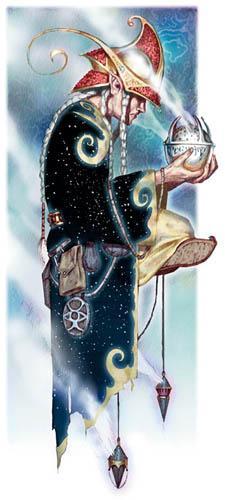
"A neutral cleric of 9th level or greater may choose to study nature instead of remaining among "civilized" areas. This type of cleric is called a druid." - Dungeons & Dragons, Players Companion: Book One

This article discusses prestige classes and unintentionally seeks a goal that turns them into an insidious trap.

I love prestige classes. My standard operating procedure in games is when players hire henchmen, if they survive to level one, they receive a class. Examples of classes that have been acquired by my player's henchmen include Woodsman, Dandy, Incantrix, Thug, Jester, and Deathmaster.

Humans have a lot of flexibility in how they gain levels. But that doesn't negate the ability for them to enter a special prestige class either. In fact, such an idea is awesome!

So what's the trap in Prestige classes?


If you are sitting around with your friends playing a game, you should be actively playing the game now.

"This build doesn't work yet, I'll need to get to level 5 to really make it work."

"I know that feat seems kind of useless, but I have to pick it up so I can get two levels in this prestige class."

"What do you mean, where do I find a member to teach me? It's right here in the book and I qualify for it, so I'm going to take a level in it."

The problem with codifying prestige classes is that players cannot help but focus on what they are going to be instead of what they are. This isn't a problem with prestige classes, this is a problem with codifying them. So we don't need a book of prestige classes, we don't need a book filled with restrictions and limits and builds. We really don't even need rules on how to construct a prestige class.

What do we need?

Simply the idea that perhaps somewhere in the world is someone willing to teach you something you don't
already know.

I am no large fan of worrying a great deal about taking efforts to maintain verisimilitude. Any group of people willing to role-play should in a matter of seconds be able to come up with a reasonable explanation for any event that occurs in game. In this case, I believe the concept of prestige classes is greatly improved when it's approached not from a mechanical angle, but from a fictional one.

Hints should be dropped of strange sorcerous cults. Non-player characters with bizarre powers and abilities not listed in the handbook should be met. Monsters may know ancient techniques that they will only share with those adventurers brave enough to enter their lair unarmed. Strange beings from the void move about in secret in large cities and only by stowing away in their hidden ships may their secrets be uncovered. Ancient texts contain forgotten and hidden-

But that's enough isn't it? You have ideas of your own bait to drop into your campaign at this point, just to see which players bite.

What don't we need?


You don't need rules to stat up a class. Quick, think of four or five powers a pyromancer might have! Think of some restrictions to go with it! BAM. You have a new prestige class. Use any book, any resource to get ideas and drop some hints in your campaign this week.

To his credit, Venger finishes his article with "I thought it was important to sow the seeds of imagination before anything else.  In fact, I would rather have a short paragraph describing each career path than a list of numbers, bonuses, modifiers, and rules." and that does sound like a good idea.

On the Gameable NPC

Telecanter has an superlative post on an implementation of NPC's as locks. The kind of post that kickstarts your game and makes you want to design something that you can use in the game right now.

So, how do we implement this as functional?

Here are my thoughts.

The card design Telecanter made is brilliant. It contains space for an image, visible traits, and what tumblers (interactions) we can make to unlock information.

The picture and the visible traits serve the purpose of avoiding the basic confrontational stance that players always end up in to meet their goals when interacting with NPC's. The image and traits, as well as the introduction used by the Dungeon Master will provide clues as to which techniques will work best against the NPC. These traits can be generated from the link to the Character Traits.pdf (author unknown) on my sidebar, or whatever tool you use to generate NPC personalty. A automated one is online at B/X character creator.

Failure Conditions

First, We need a mechanic for creating a cost in the interaction. Otherwise players could just go down the list trying different things. It is important that this cost take into account the charisma of the player. Fortunately we already have that mechanic, in the 2d6 Reaction Roll. Each action taken will reduce or raise the reaction value by a specified amount with certain conditions (storming off in a huff, fighting, pressing charges, spitting, joining the party, etc.) occurring when values are met.

Note that this is extremely similar to the relationship mechanic in pathfinder or various bioware relationship games. What makes this different are the locks -- activities which unlock specific behaviors or events, rather then just timed events or specific actions that increase a singular numeric score. The score is simply to track win or endgame conditions, so that the process cannot be infinitely gamed.

Interactions

Second, we need a list of interactions and a list of rewards and results!

Designing the list of interactions first involves an iterative collections of various options that are significantly or noticeably different from each other.
  • We want the list to be comprehensive, not in the extent that it be huge and cover every possible action, but in the sense that any action the player characters take could be fit within it. 
  • We also desire for the list to be evocative. If this were a mechanical system not dealing with sentient creatures, I would suggest a limit of 7 to 9 things. But human beings are complicated creatures, so creating a system with more options then we can easily keep in mind provides a sense of that complexity to the players (who after all, are interacting with a picture, two descriptive words, and three optional action/results.

We also have to worry about speed and conciseness. Not every option should unlock a tumbler and not every option will be good or bad. A simple way to track this is to say any unlisted option reduces the reaction level by 1. Actions that raise the reaction level (I would suggest by no more than 1) or lower the reaction level a greater amount (by 2 or 1-4 for example) would be rare and specifically noted.

An optional rule, is that a particular conversational stance, such as obsequiousness, friendly, or hostile is selected, and this gives a one time adjustment to the reaction track.

Rewards and Results

Thirdly, we need a list of what you get for unlocking the NPC! This has less to do with a specific list of items, after all, context will suggest many of the rewards. What this has to do with is acting as inspiration or random generator for those 'NPC' results generated in the dungeon.

I also believe for ease of use that perhaps results of 'NPC party' should be treated as a single NPC in this case.

Comments, Thoughts, Conclusion and Two Lists


The most exciting thing about this system, is that a simplified form could be used to handle encounter checks when the players decide to parley. Factions within a dungeon could be treated as a single NPC, allowing the players to gain alliances and other rewards based off the way individual encounters go.

Even though this is the mechanical system behind NPC reactions, the experience for the players should not change. Their interactions with the NPC's should remain organic and interpreted by the Dungeon Master. Players should not feel as if they are playing a computer game, this system exists to aid the Dungeon Master in adjudicating NPC interactions impartially.

Here is a list of options for interaction:
Action Options: Drinking, Flirting/Seducing, Intimidate/Threaten, Demanding (robbing, etc.), Ignoring, Honoring, Bribing (gold/magic item/food/etc.), Trade, Question/Interrogate, Pray/Convert, Seek Aid, Offer Aid, Surrender/Grovel, Flee, Gambling, 

Each of these is specific and should be individualized. If the player characters say 'we give him 100 gold', and what he really wants is food, the replay should give the players the information. "Aye, I'll take your metal, but it does little for my empty stomach."

Here are some ideas for rewards. These are less regimented and are merely meant to provide inspiration for the possible results of unlocking tumblers.

Teaching a spell, Telling about another NPC/Faction, Joining the party, Giving a quest, Handing over a reward in thanks, Telling about a trap, giving the players a map, Guiding the players somewhere, Teaching a skill, Unlocking a playable race, Unlocking a new special ability.